
Affiliate disclosure: Some links below may earn us a commission at no cost to you.

HeyReach
LinkedIn outreach built around rotating unlimited senders at one flat cost — priced per LinkedIn account, free for every human on the team.
$79/mo per sender (Growth, monthly billing; 14-day trial, no card)
Try HeyReach Full review →
Salesforge
Unlimited-sender cold outreach with a bundled AI SDR — the sending layer is one invoice, the mailboxes, credits, and Agent Frank are others.
$40/mo billed annually (Pro plan; ~$48 monthly; 14-day trial)
Try Salesforge Full review →Our pick
HeyReach
Best for LinkedIn-heavy outbound teams and agencies — Growth $79/mo per sender (monthly billing), humans free, Unlimited at $2,999/mo flat; BYO proxies above Growth.
For agencies and teams whose pipeline lives on LinkedIn — SaaS founders, recruiters, high-ticket services — HeyReach wins: sender rotation with per-sender proxies is built for volume inside LinkedIn's limits, and teammates log in free. For teams whose channel math favors email and want one invoice covering sending, warm-up, and an AI SDR, Salesforge at $40/mo annual is the entry point — with the catch that 'unlimited mailboxes' means unlimited connections to mailboxes you pay its siblings (Mailforge/Primeforge) to host.
Feature comparison
| Feature | HeyReach | Salesforge | Winner |
|---|---|---|---|
| Starting price (verified Oct 2026) | Growth $79/mo per LinkedIn sender | Pro $40/mo annual — unlimited sender connections | — |
| Trial | 14 days, no card | 14 days | — |
| Primary channel | LinkedIn: rotation, per-sender residential proxies | Email: Warmforge warm-up, rotation, dynamic IPs | — |
| Email leg | Native syncs to Instantly/Smartlead/EmailBison with verified email finding | Native — sending platform with AI SDR (Agent Frank) | — |
| Unified inbox | API/webhooks/MCP/CLI; Clay and RB2B triggers | Primebox: email + LinkedIn replies with sentiment tagging | — |
| Team economics | Humans free — only LinkedIn accounts bill | Unlimited users from Growth | — |
| Billing record | Support pace slipping per long-tenured users (24–48h) | Trustpilot 59% 5-star / 28% 1-star; no-refund terms; Leadsforge cancel friction | — |
Side-by-side deep dive
What it does best
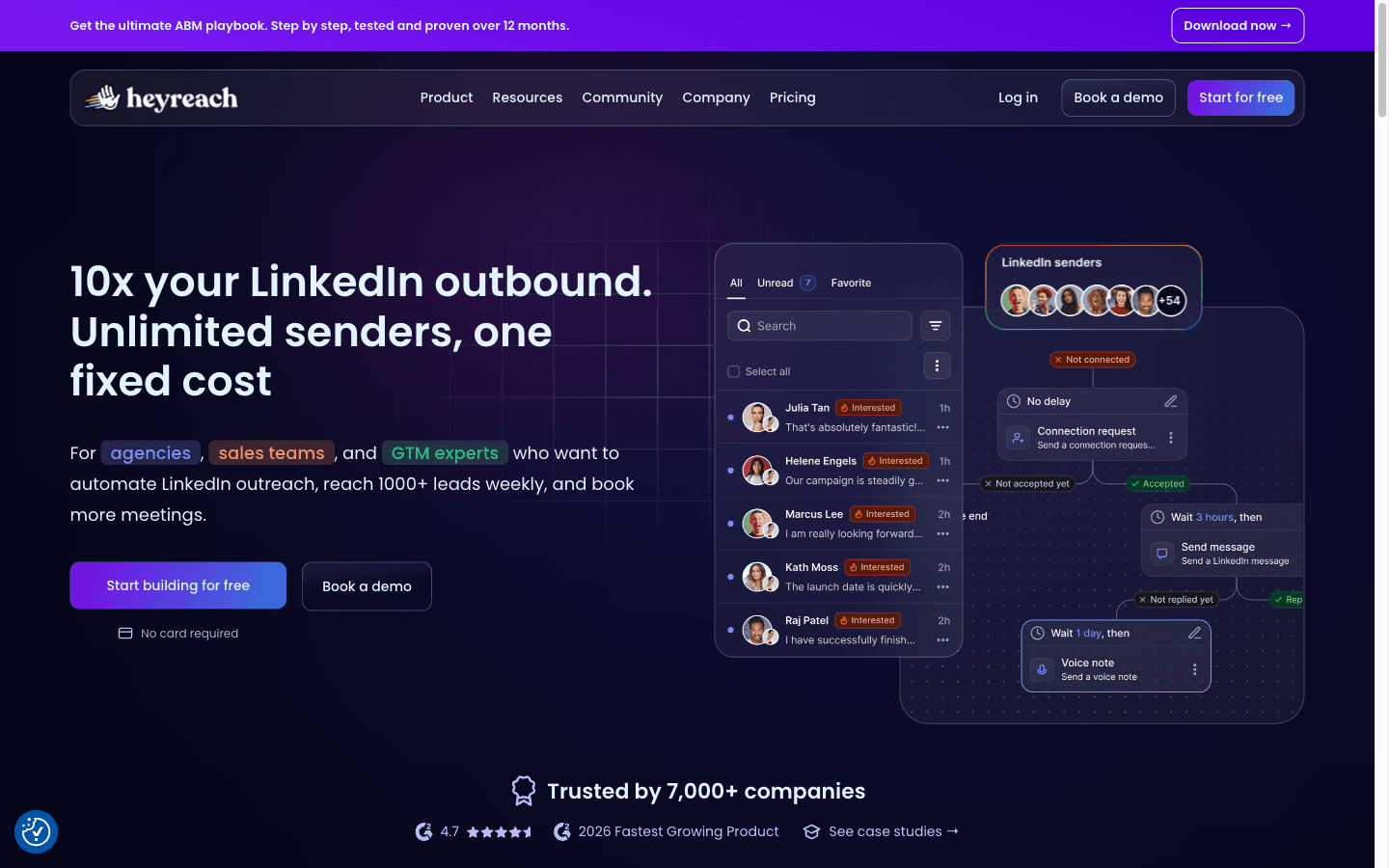
- Seat economics favor teams: only connected LinkedIn accounts bill, so teammates, VAs, and client stakeholders all log in free.
- Sender rotation is the product's core idea — spreading volume across accounts with a dedicated residential proxy per sender on Growth, built for staying inside LinkedIn's limits.
- Multichannel is native, not bolted on: Instantly, Smartlead, and EmailBison syncs come with verified-email finding built in, and HubSpot sync is verified by HubSpot itself.
- Builder-grade surface: API, webhooks, MCP server, and CLI, plus Clay, RB2B, and signal-based triggers that push site visitors straight in as warm leads.
The catch
- "One fixed cost" headlines the $2,999 Unlimited tier — Growth actually bills per sender, so a 10-sender agency pays $790/mo and only beats Agency pricing around 13 senders.
- Agency and Unlimited plans require bring-your-own proxies — an extra invoice and setup chore the flat-fee pitch leaves out.
- Pacing constraints are real: G2 reviewers note enforced minimum gaps between messages, and no automation removes LinkedIn's ban risk.
What it does best
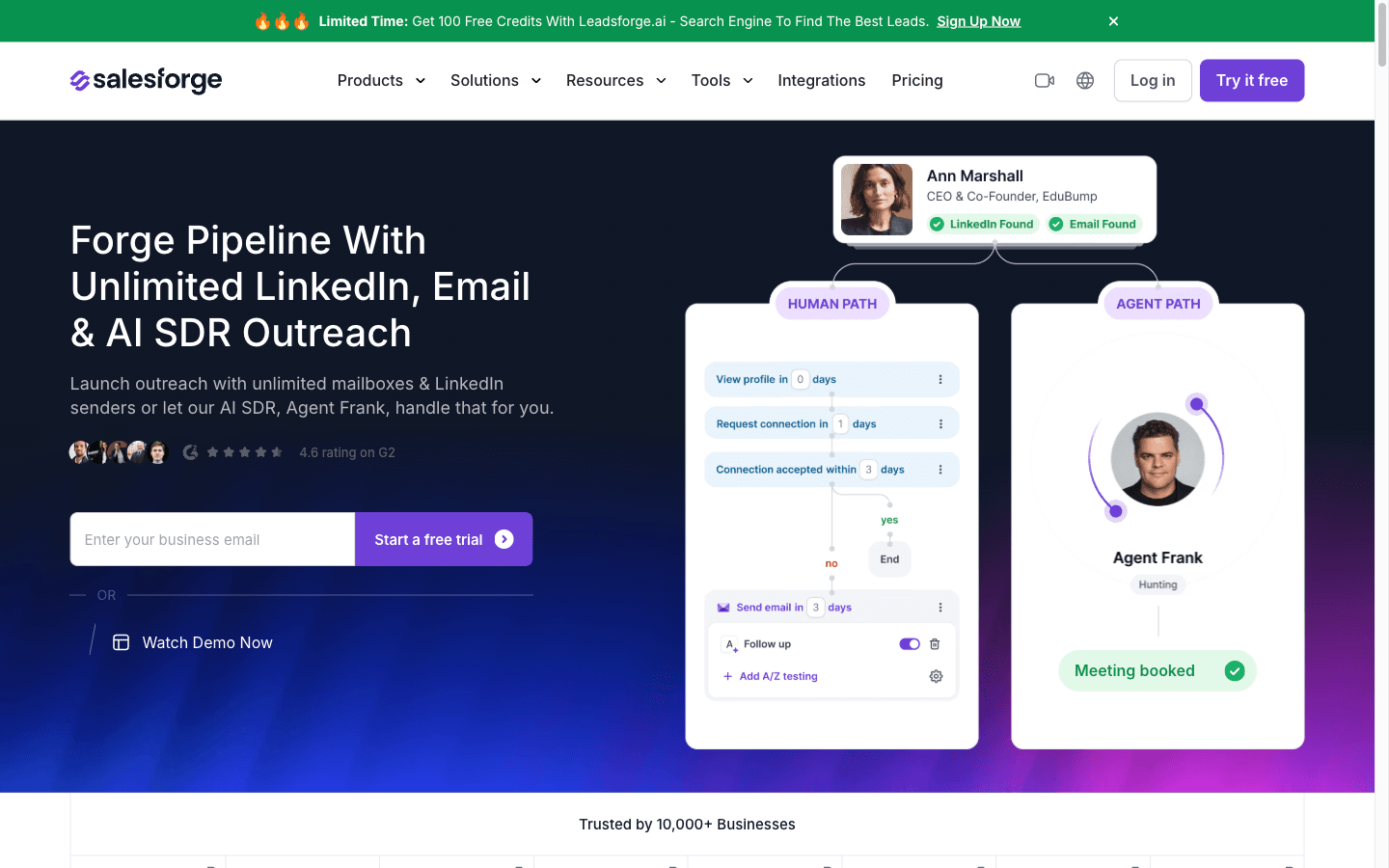
- The unlimited-sender model is real: unlimited mailbox connections on every plan, unlimited LinkedIn senders and unlimited users on Growth — no per-seat math as the team grows.
- Deliverability machinery ships free: unlimited Warmforge warm-up, smart mailbox rotation, dynamic IPs, and Heat Score monitoring built into the subscription.
- Primebox unifies email and LinkedIn replies — including responses sent to different addresses — with AI analysis and sentiment tagging in every tier.
- Agent Frank is a full-loop AI SDR (prospecting, copy, follow-ups, booking) with a co-pilot mode, not just a copy generator.
The catch
- "Unlimited mailboxes" counts connections, not mailboxes — the mailboxes themselves are paid siblings (Mailforge, Primeforge), a split the company's own Trustpilot replies admit was under-explained.
- Getting out has friction: Leadsforge subscriptions can't be canceled from settings, and the terms allow no refund once a renewal has processed.
- Pro caps you at 1 LinkedIn sender — the unlimited-sender promise effectively starts at Growth, $80/mo billed annually.
Pricing showdown
| Plan | HeyReach | Salesforge |
|---|---|---|
| Free plan | No | No |
| Pricing type | paid | paid |
| Starting price | $79/mo per sender (Growth, monthly billing; 14-day trial, no card) | $40/mo billed annually (Pro plan; ~$48 monthly; 14-day trial) |
| Enterprise | Custom | Custom |
Use-case matching
Choose HeyReach if...
- LinkedIn-heavy outbound teams and agencies — Growth $79/mo per sender (monthly billing)
- humans free
- Unlimited at $2
- 999/mo flat; BYO proxies above Growth.
Choose Salesforge if...
- Email-first multichannel senders — Pro $40/mo annual (~$48 monthly)
- unlimited sender connections
- warm-up included; LinkedIn sending unlimited from Growth at $80/mo annual.
Final verdict
Our pick: HeyReach
For agencies and teams whose pipeline lives on LinkedIn — SaaS founders, recruiters, high-ticket services — HeyReach wins: sender rotation with per-sender proxies is built for volume inside LinkedIn's limits, and teammates log in free. For teams whose channel math favors email and want one invoice covering sending, warm-up, and an AI SDR, Salesforge at $40/mo annual is the entry point — with the catch that 'unlimited mailboxes' means unlimited connections to mailboxes you pay its siblings (Mailforge/Primeforge) to host.
Full comparison
Method
Researched from both vendors' pricing pages, docs, and review profiles, verified 2026-10-26/27. Research-only — no live outbound sequences were run on either platform. The channel-choice framing (LinkedIn-first vs email-first) is the question agency buyers actually ask first.
The catch on each side
HeyReach's catch is the flat-fee illusion. 'One fixed cost' headlines the $2,999 Unlimited tier, but Growth bills per sender — 10 senders cost $790/mo and only beat Agency pricing around 13 senders. Agency and Unlimited require bring-your-own proxies (an extra invoice and setup chore), G2 reviewers note enforced minimum gaps and lingering ban risk, and a 2-year customer reports support slipping to 24–48h waits.
Salesforge's catch is the sibling invoice. 'Unlimited mailboxes' counts connections, not mailboxes — the mailboxes live on paid siblings Mailforge/Primeforge, a split the company's own Trustpilot replies admit was under-explained. Pro caps you at 1 LinkedIn sender (unlimited starts at Growth, $80/mo annual), Leadsforge subscriptions can't be cancelled from settings, terms allow no refund after a renewal processes, and Trustpilot splits 59% five-star against 28% one-star — including a Primeforge incident where paid domains vanished from a customer dashboard.
When to use both
True multichannel shops do: HeyReach owns the LinkedIn rotation while Salesforge owns the email leg, with HeyReach's native sync pattern keeping the two in step. The combined floor is ~$120/mo — before that, most teams should just pick their dominant channel's tool.
The one-liner
HeyReach is LinkedIn-first — rotate senders, keep humans free; Salesforge is email-first — one Forge invoice for sending, warm-up, and the AI SDR.
Full breakdowns: HeyReach · Salesforge · the wider stack: best AI sales tools · also compare Inframail vs Salesforge for the infrastructure layer. Long-form decision guide: HeyReach vs Salesforge.
Commission note: HeyReach pays 30% on Starter / 15% on Agency (Tolt); Salesforge pays 15% recurring (Tolt) — per network data verified 2026-10-27. Figures above are from vendor pricing pages verified 2026-10-26/27. We also recommend tools with no affiliate program when they're the best fit.
Frequently asked questions
Is HeyReach or Salesforge better for agencies?
Does Salesforge include mailboxes?
Can HeyReach send email too?
Which tool is safer for LinkedIn accounts?
You might also compare
Evaluated by workflow fit, output quality, and pricing transparency. How we review →