Track Keyword Rankings Without the $99/Month Tools (2026)
Last updated: October 27, 2026 | Pricing verified 2026-10-26/27 from each vendor's own pricing pages and FAQs. Research-only: I have not run either tracker on a live site for a full tracking cycle yet — everything below comes from vendor docs, pricing pages, and the documented review record.
Rank tracking has a pricing anchor problem. The tools everyone names — Ahrefs, Semrush — start around $99–129/mo, so "affordable" in this category quietly means anything under $50. That framing is wrong for most solo publishers and small sites, because rank checking is a daily-read job, not a platform job, and the market has split: one budget suite does keywords plus tracking for the price of a gym membership, and one mid-market tracker now does something the $99 suites still don't — tracking whether AI engines cite you at all.
Quick verdict: solo publishers tracking under ~100 keywords should start free (Google Search Console), then add KeySearch at $24/mo when they need daily rank checks plus keyword research in one place. Sites whose traffic depends on AI search referrals should evaluate Nightwatch from €79/mo annual — it's the only tracker we've verified that joins Google positions to ChatGPT/Perplexity citations. Neither is "Ahrefs but cheap"; they're smaller, honest about it, and priced like it.
First: you might not need to pay at all
Google Search Console gives you average position, impressions, and clicks for every query you already rank for — free, unlimited, straight from the source. If that's all you check, stop reading and open GSC.
What GSC can't do defines the paid tier: it shows no positions for pages that don't rank yet (no impressions = no data), no competitor rankings, no position history beyond 16 months in a clunky export, no local/zip-code precision, and no scheduled alerts when a keyword drops. It also tells you nothing about AI citations — GSC sees ChatGPT traffic only after a human clicks through.
The honest sequence for a new site: GSC from day one, paid tracker when you catch yourself checking GSC twice a day and wanting numbers it can't show. That moment usually arrives around 30–50 keywords you actually care about.
KeySearch — the $24 anti-platform
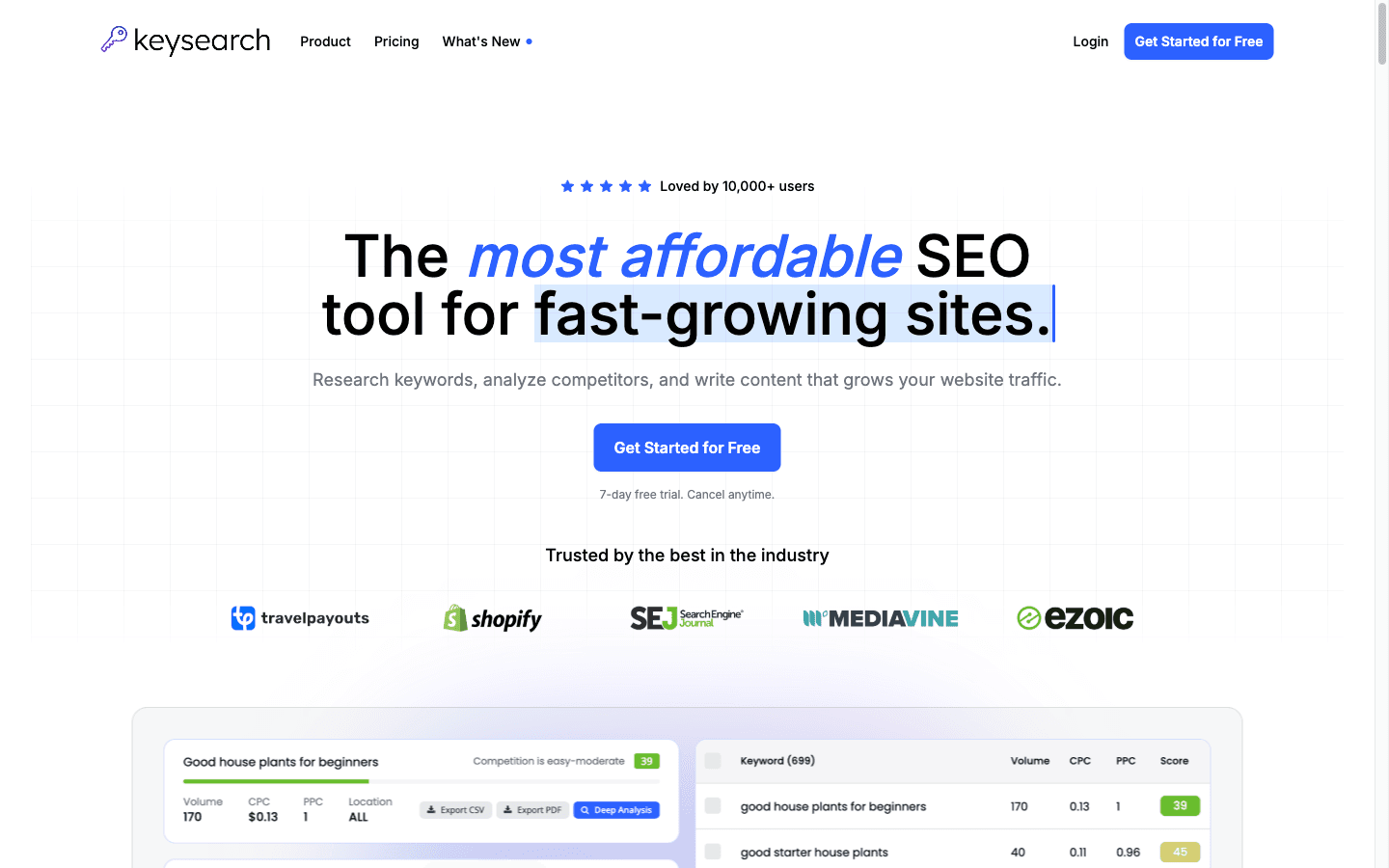
KeySearch is a full SEO suite — keyword research, live SERP analysis, backlink checks, site audits, YouTube research, and rank tracking — where the headline fact is the price ($24/mo Starter) and the fine print is the daily caps.
What $24/mo actually buys, verified on their pricing page (2026-10-26): 200 keyword searches per day, 80 tracked keywords, live SERP analysis, competitor analysis, backlink analysis, YouTube research, an SEO auditor, and rank tracking. Pro at $48/mo raises the walls to 500 searches/day and 200 tracked keywords and unlocks the Foresight AI engine. A 7-day free trial with cancel-anytime makes the evaluation free.
Three things make KeySearch credible beyond its price. It has run since 2015 — the surviving budget tool in a category that eats them. Long-term Trustpilot reviewers repeatedly mention new tools arriving inside the existing subscription, which is the opposite of the shrinkflation pattern. And the vendor's own comparison pages pick fights ("vs Ahrefs: steep learning curve and a high price tag") with confidence you only get from a product that knows exactly what it is.
The catch, stated as plainly as the price: the caps are hard and daily. A heavy research day — site migration, niche pivot, client onboarding — hits 200 searches and stops. Trustpilot sits at 3.5/5 from 28 reviews with complaints that repeat: duplicate charges after plan changes (one running 15 months with a partial refund), a non-working cancel button, an account deactivated after a card was locked. The vendor replies to none of them. The review base is also thin and dated — 2 reviews in the last 12 months — so the 4.9/5 shown on their own site is vendor-sourced, not the current picture.
True cost note: the annual toggle only says "2 months free" with no per-month annual price rendered — unusual opacity in 2026, and you should assume the monthly price is the real quote until support states otherwise. Where KeySearch sits in a full budget stack: best AI SEO tools, budget table.
Best for: solo publishers and small-business owners who research in bursts, track under 100 keywords, and want one subscription instead of three. Skip it if you run daily client reporting across dozens of sites — the caps and the thin support record will both bite.
Nightwatch — the tracker that watches AI citations too
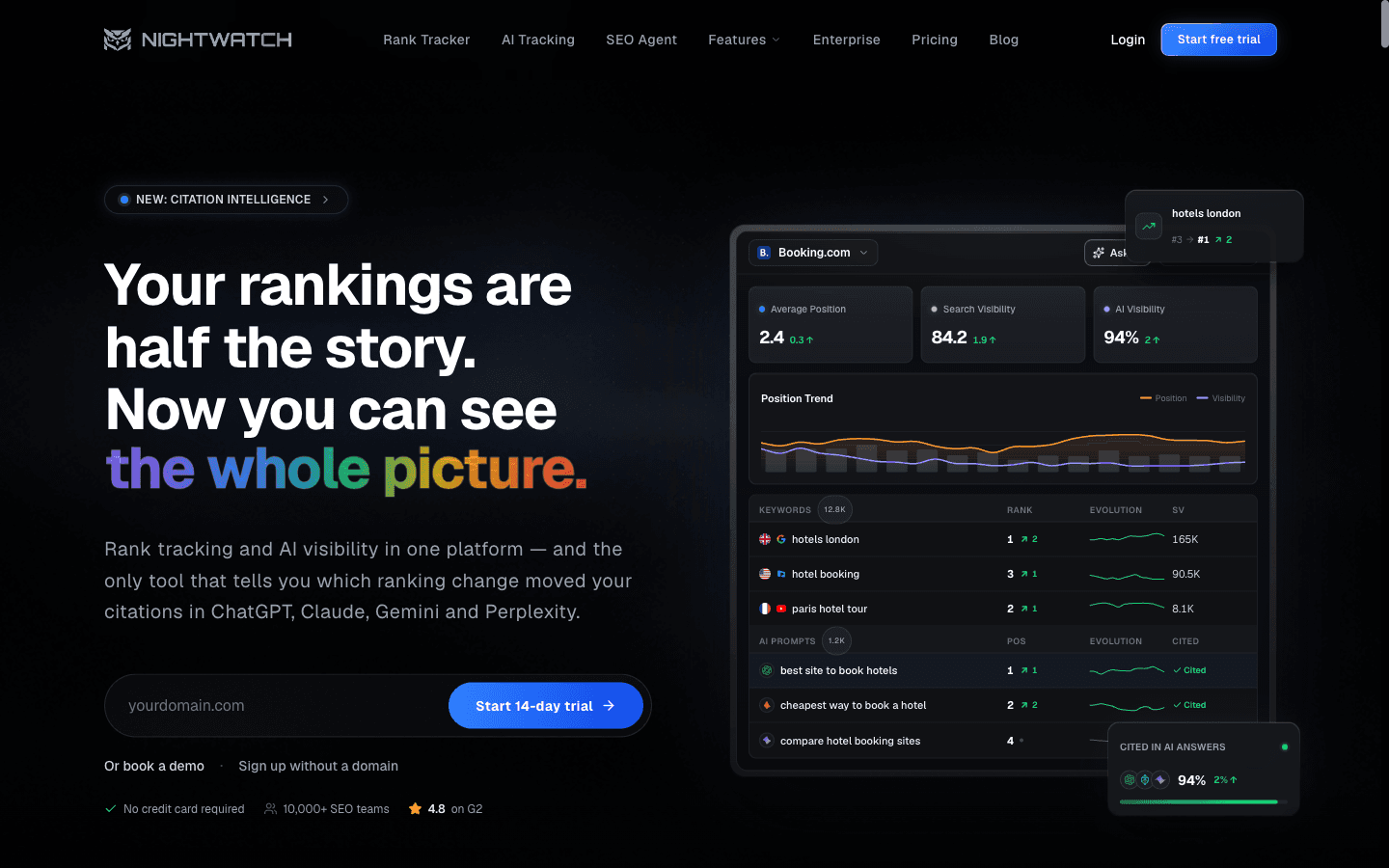
Nightwatch is a dedicated rank tracker (€79/mo annual for 500 keywords) whose 2026 differentiator is Citation Intelligence — ranking history joined to your citations in ChatGPT, Claude, Gemini, and Perplexity, so a traffic drop can be traced to the AI answer that stopped citing you.
The tracking core is serious. Every rank check stores the raw SERP HTML as an audit receipt — which is how a vendor backs a 99.9% accuracy claim with evidence rather than adjectives. Zip-code precision across 107,000+ locations, on-demand refreshes instead of daily batches, and ranking history the vendor traces back to 2012. Every plan ships the full toolkit: Content Studio, Site Audit, keyword and prompt research, an SEO MCP server, a Search Simulator, white-label reports arriving at Professional.
Citation Intelligence deserves a separate sentence, because it changes what "rank tracking" means in 2026. Google position 4 with an AI citation is a different business than position 4 without one — AI answers now absorb clicks that never reach the SERP, and every other tracker in this price class reports only the SERP half. Nightwatch monitors six AI platforms and joins that record to your keywords. For sites whose niches get answered (tools, how-tos, comparisons — this includes most of our readers), that's the feature.
The catches, and Nightwatch has several. Headline prices are annual-commitment rates: €79/€159/€399 per month billed yearly becomes €99/€199/€499 month-to-month per their own FAQ — roughly 25% more, the largest annual-vs-monthly spread we verified in this category. Everything AI-side is metered: keywords step 500 → 2,500 → 7,500 → 20,000 by tier, AI answers cap at 1,500/4,500/15,000 per month, and the NightOwl SEO agent burns credits (100/1,000/5,000) every run. No Trustpilot page exists at all — the URL 404s as of 2026-10-26 — so the consumer-billing record rests entirely on G2 (4.7/5 from 64 reviews, reporting and accuracy the praised points). And the site's own numbers don't reconcile: it claims 4.8 from 310 G2 reviews where G2 shows 4.7 from 64, and promises unlimited seats on every plan while its comparison table shows unlimited seats from Professional up. None of that is disqualifying. All of it belongs in your evaluation notes.
Best for: agencies and site owners who report on AI-search visibility, track locally, or need audit-grade position history. Skip it if you track a personal blog — you'd be paying for metered capacity you'll never fill.
Head to head
KeySearch wins on price-per-feature for one site; Nightwatch wins on tracking depth and the AI-citation dimension; GSC wins at $0 and stays installed regardless.
| KeySearch | Nightwatch | Google Search Console | |
|---|---|---|---|
| Starting price (verified Oct 2026) | $24/mo (Starter) | €79/mo annual (€99 monthly) | Free |
| Keywords tracked | 80/mo (500/day searches) | 500 → 20,000 by tier | All queries with impressions |
| Rank data source | Third-party checks | Raw SERP HTML receipts, 107K+ locations | Google, directly |
| Keyword research | Full suite, included | Included (Keyword + Prompt Research) | None |
| AI citation tracking | None | 6 platforms (ChatGPT, Claude, Gemini, Perplexity…) | None |
| Position history | Yes, subscription-limited | Vendor-documented to 2012 | 16 months |
| Local/zip precision | Limited | Yes, on-demand refresh | Country-level |
| Free trial | 7 days | 14 days, full features, no card | — |
| Documented risk | Daily caps; billing complaints, no vendor replies | Annual-locked pricing; metered AI features; self-reported ratings don't match G2 | No competitor or non-ranking data |
Two honest limits of this table: I haven't cross-checked KeySearch's rank accuracy against Nightwatch's on identical keywords — that's the scan battery this article doesn't contain yet. And Nightwatch's EUR pricing means USD buyers take exchange-rate movement on top of the annual commitment.
The decision, by situation
under 100 keywords and one site, GSC + KeySearch. AI search matters to your revenue, Nightwatch. Multiple client sites with daily reporting, neither — that's still the $99+ platforms' territory, and pretending otherwise burns hours.
- New site, first 6 months: GSC only. Spend the $24 on nothing yet — you don't have enough ranking queries to justify a tracker.
- Solo publisher, ~50–100 keywords that matter: KeySearch Starter ($24/mo). One subscription covers the research you're already doing plus the tracking GSC can't.
- Site earning from AI referrals: Nightwatch Starter (€79/mo annual). Citation Intelligence is the only verified way to see the ChatGPT half of your search presence. Trial for 14 days first, and do the math on monthly billing before committing annually.
- Agency, 10+ client sites: neither. You need bulk tracking, client permissions, and API depth that starts at SE Ranking ($129/mo Core) and Ahrefs territory. The budget tools' caps exist precisely to exclude you.
- Anyone, any tier: keep GSC installed. Both paid tools complement it; neither replaces the source.
One line worth keeping: cheap rank tracking is a real category now — the mistake isn't paying too little, it's paying platform prices for tracker-sized jobs.
Final verdict
For the site I'd run myself: GSC from day one, KeySearch's 7-day trial the week the first 30 keywords start ranking, and a paid plan only if the trial's numbers survive contact with my actual checking habits. Nightwatch goes on the evaluation list the month AI referrals show up in analytics as more than a rounding error — that's the trigger its pricing model fits.
What I'd avoid: annual billing on either tool in the first quarter, and the habit of checking rank data daily. Positions move daily; decisions shouldn't.
Last updated: October 27, 2026.
FAQ
What is the cheapest way to track keyword rankings?
Google Search Console — free, unlimited, first-party. It covers position, impressions, and clicks for anything you already rank for. The cheapest paid option we've verified is KeySearch at $24/mo, which adds competitor rankings, scheduled tracking for keywords that don't yet rank, and a full keyword-research suite.
Is KeySearch worth it compared to Ahrefs?
For keyword research and rank tracking on one or two sites — often yes, at 20% of the price. Ahrefs wins on index size, backlink depth, and API. KeySearch wins on price ($24 vs $99+) and covers the daily jobs of a solo publisher: 200 keyword searches/day, 80 tracked keywords, live SERP analysis. The documented trade-offs are the hard daily caps and a thin, unanswered Trustpilot record (3.5/5) — Ahrefs has neither problem and costs four times as much.
What is AI citation tracking?
Monitoring whether AI engines — ChatGPT, Claude, Gemini, Perplexity — cite your pages in their answers, joined to your traditional rankings. Nightwatch's Citation Intelligence is the implementation we've verified: it traces ranking history (documented to 2012) against AI citation records across six platforms, so you can see whether a traffic drop coincided with an AI answer that stopped citing you. Conventional trackers don't see AI answers at all.
Do free rank trackers work?
For basic needs, yes — GSC is genuinely enough for many small sites. Free tiers beyond that are trials in disguise: KeySearch gives 7 days, Nightwatch gives 14 with full features and no card. The one free tool worth permanent installation is GSC itself; everything else free in this category is a lead magnet with a countdown.
How many keywords should I track?
Fewer than you think: the 20–50 keywords where a position change changes a decision, not the 2,000 your tool can technically hold. KeySearch's Starter cap of 80 tracked keywords is a feature in disguise for solo publishers — tracking noise trains you to ignore the dashboard. Agencies running client reports are the exception, and they're the buyers the $99+ platforms are built for.
Disclosure: This page contains affiliate links. KeySearch and Nightwatch have active affiliate programs. We also recommend tools with no affiliate program when they're the best fit — including Google Search Console, which is free. Pricing verified from vendor pages 2026-10-26/27 and can change.