DocHipo vs Visme: The Budget Design Seat or the Brand Governance Suite? (2026)
Last updated: October 27, 2026 | Method — read this first: research-only. We have not run a production design workflow on either tool. Both pricing pages were captured 2026-10-26, review records were read the same week, and every number below traces to one of those two sources.
Here's the thing that makes this comparison annoying: at list price, the seats cost the same. DocHipo Pro runs $12/user/mo billed yearly; Visme starts at $12.25/user/mo billed yearly ($147). A dollar-thirty-a-year difference is not a decision. The decision is what the seat is for — and the two tools are built for visibly different jobs.
Quick verdict, by persona: if you're a solo marketer or a small business whose heaviest design work is proposals, one-pagers, and social content, DocHipo is the pick — the proposal maker ships interactive pricing tables, scope-of-work tables, and a built-in e-signature that normally require separate proposal software, the AI tools (writer, translate, image generator, background remover) come bundled in the Pro seat, and it undercuts Canva Pro's $15 listing while doing it. If you're a marketing team of three or more that lives in decks, reports, and data graphics — and someone above you cares that everything stays on-brand — Visme earns the seat: Brand Kit enforcement, 50+ chart and widget types with Google Sheets sync, and interactive publishing with view analytics are things DocHipo doesn't attempt.
If you remember one line: DocHipo is proposal-first and price-first; Visme is brand-first and data-first.
What you're actually choosing between
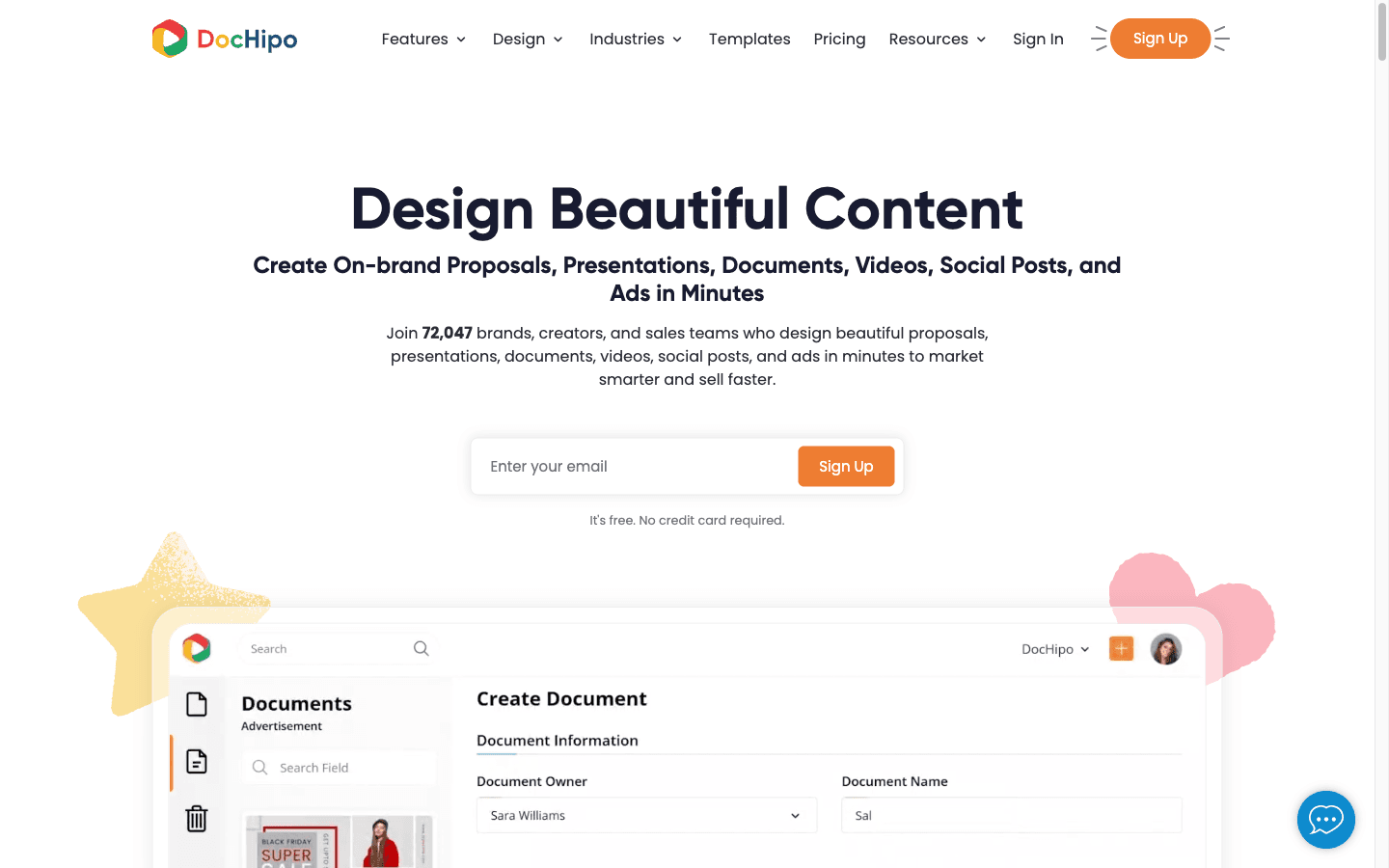
DocHipo's positioning is written in its product shape. The proposal maker is the deepest surface: interactive pricing tables where a client can toggle options, project timelines, multiple currencies, e-signature. Around it sit the generalist tools — social posts, ads, video — with AI Writer (OpenAI-powered), AI Translate across 100+ languages, an AI image generator, and a background remover bundled rather than upsold. Downloads carry no watermark even on the Free plan, and signup needs no credit card, so a real evaluation costs nothing but an hour.
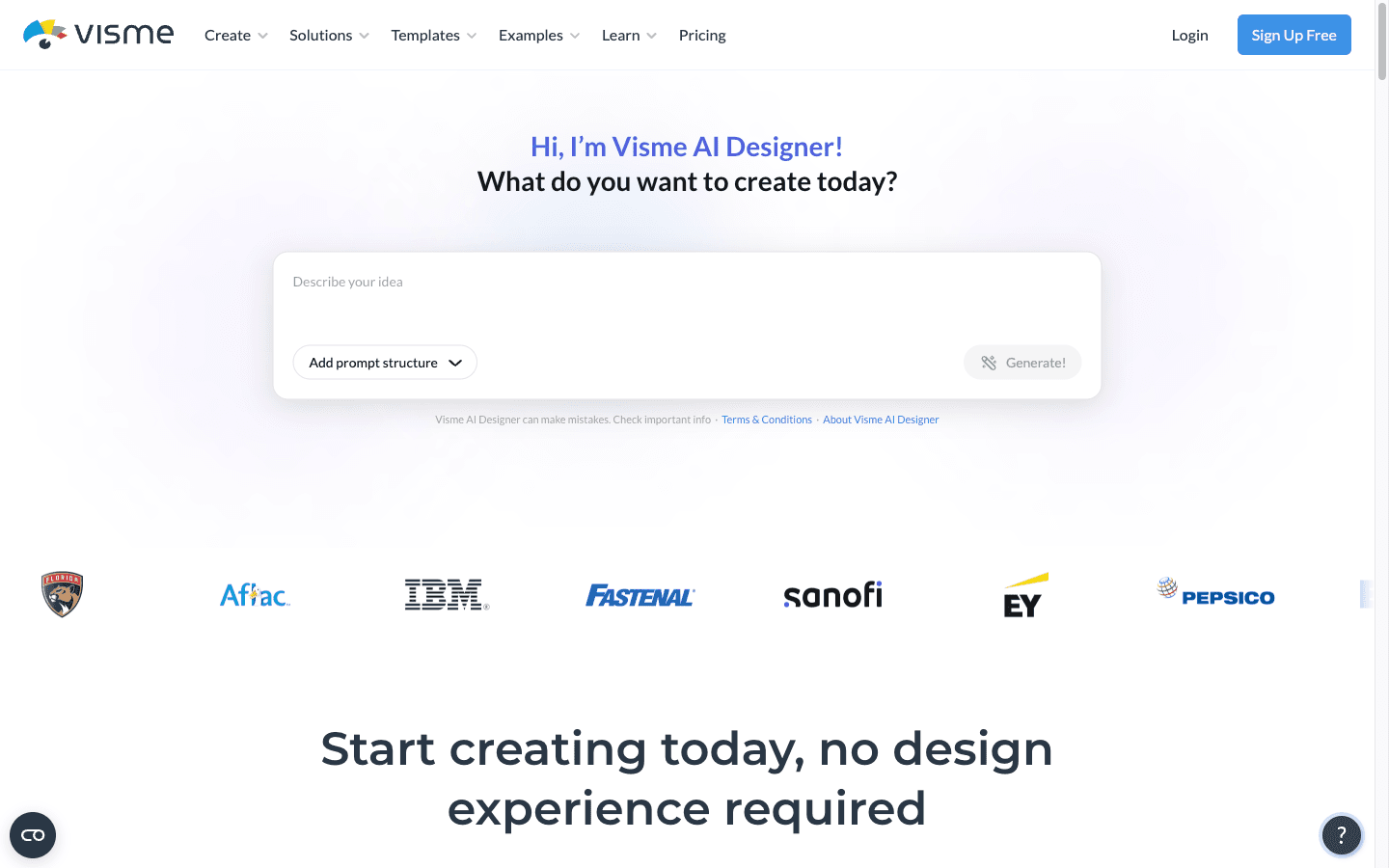
Visme's positioning shows up in its feature ladder. The capabilities that justify the seat sit at Business and above: Brand Kit, custom fonts, master layouts — the governance layer that keeps 20 non-designers producing output that looks like one company made it. Below that layer, the differentiator is data: 50+ chart, graph, and widget types plus maps, with Google Sheets and Excel imports that stay synced as numbers change. And the output itself can be interactive — hotspots, pop-ups, animation, live-link publishing with view analytics — which is the capability Canva-switching reviewers cite when they explain why they pay Visme's premium.
One more difference that matters more than it sounds: Visme evaluates for free with no time limit — every AI tool works on the free plan at 10 credits a month, but exports stay locked. DocHipo's free plan is the inverse: 5 documents, and you can download them watermark-free, but AI tools and premium templates wait for Pro. Evaluate accordingly — Visme lets you build everything and ship nothing; DocHipo lets you ship a little of everything and build more.
Head-to-head
| DocHipo | Visme | |
|---|---|---|
| Price per seat (verified 2026-10-26) | Pro $12/user/mo yearly ($15 monthly) | $12.25/user/mo yearly ($147/yr); Business higher |
| Free tier | 5 documents, watermark-free downloads, no AI tools | Unlimited drafts, zero exports, all AI tools (10 credits/mo) |
| Proposals & docs | Interactive pricing tables, scope-of-work, e-signature built in | General business docs; no e-signature |
| Data visualization | Basic charts | 50+ chart/widget types, maps, synced Sheets import |
| Brand enforcement | Brand assets per seat | Brand Kit, custom fonts, master layouts (Business+) |
| Interactive output | Not a focus | Hotspots, pop-ups, animation, live links with analytics |
| Review record | G2 4.6/5 from 4 reviews (3 incentivized); no Trustpilot | G2 substantial; Trustpilot billing-led, slow vendor replies |
The catch on each side
DocHipo's catch: the unproven record
The feature list is long and the proof base is thin. G2 shows 4.6/5 from exactly 4 reviews — and G2 itself flags 3 of the 4 as incentivized or invite-sourced, with the platform's own note that such samples give no buying insight. Capterra's 4.89 comes from 19 reviews. Trustpilot has no DocHipo profile at all. There is no independent record of how this tool behaves at month six under a real team.
The most detailed G2 review available reports the concrete limitation: no numeric input for positioning, spacing, or sizing, and customization that feels limited next to Illustrator or CorelDRAW. For proposal-and-social work that's survivable. If your designers live by the pixel grid, it's disqualifying. Smaller frictions stack around the edges: no tablet app per a G2 reviewer, English-only interface and support, and subscriptions that auto-renew — the vendor FAQ's own advice is to cancel before the renewal date.
Visme's catch: the renewal billing pattern
Visme's Trustpilot record isn't about design quality — it's about the invoice. Plans renew automatically one year after signup at full price; Visme's own public replies on Trustpilot confirm the auto-renewal mechanic. Reviewers report a $300 renewal charged to an expired card on a service they considered lapsed, an unsubscribe option two separate reviewers describe as buried, and vendor replies to negative reviews typically taking over a month. Calendar the renewal date when you subscribe; that's not paranoia, it's the documented pattern.
The second structural cost is lock-in: G2 reviewers report files becoming uneditable once a subscription lapses, and teammates without seats can't edit. Your back catalog of decks and infographics is hostage to an active plan — with a team of seat-holders that's fine, but a solo creator who lets a plan lapse loses access to their own work. Add the price perception: "Expensive" appears in 8 G2 con mentions, a nonprofit reviewer pegs it at roughly double Canva's price with weaker AI background removal, and PDF export speed draws complaints. Nobody calls Visme cheap; the argument is whether brand governance is worth the premium. For teams, it usually is. For solo operators, it usually isn't.
What the seat really costs
The per-seat numbers sit a dollar-thirty apart, so the real cost analysis is about what the seat includes and what lapsing costs.
DocHipo's $12 seat bundles the AI layer: writer, translate for 100+ languages, image generator, background remover. Buy those as add-ons in most suites and the seat pays for itself — that's the honest math for a solo marketer choosing between DocHipo Pro and Canva Pro at $15. The free plan's 5-document cap is the evaluation ceiling, and high-resolution download waits for Pro, so budget the paid tier from the start if document volume matters.
Visme's seat math is a team math. Brand Kit and master layouts arrive at Business, so a three-person team evaluating on Starter plans is evaluating the wrong tier — the governance features that justify the premium are one rung up. Multiply seats by $147/year and compare against the cost of one brand-inconsistency incident (a client catching off-brand decks, a sales team shipping stale pricing) — that's the actual trade. And price the lapse scenario: files uneditable without an active subscription means the annual renewal isn't optional if the library matters.
Neither tool publishes per-seat AI credit overage rates cleanly — Visme's free tier runs 10 credits/month with paid tiers scaling from there, DocHipo bundles AI without a published cap. Treat AI volume on both as "try it and see," not "read the pricing page and know."
Where each one wins
DocHipo wins the proposals job outright. Interactive pricing tables, scope-of-work tables, project timelines, multiple currencies, e-signature — assembled as a native proposal maker rather than a template afterthought. An agency sending 10 proposals a month with pricing options a client can click through is getting capability that proposal software like PandaDoc sells separately. At $12 a seat, this is the sharpest value-for-job in the budget design tier.
Visme wins everything brand-shaped and data-shaped. Twenty people producing decks, reports, infographics, and interactive one-pagers that all look like the same company — with charts that update when the spreadsheet does — is a governance problem, and Visme built its ladder for it. The interactive publishing layer (hotspots, pop-ups, analytics on shared links) is the single capability most cited by teams switching from Canva, and DocHipo doesn't compete for it.
The solo-operator caution cuts one way. If you're a team of one who picked Visme for its template library, the renewal trap and the lapse lock-in fall on you alone with no seat-mates to share the invoice logic. Solo operators are DocHipo's natural habitat — or Canva's.
When to use both
They coexist more cleanly than same-category tools usually do, because their centers of gravity barely overlap: DocHipo as the sales-facing documents seat (proposals, one-pagers, e-signed agreements), Visme as the brand-governed presentation and infographic engine. Two seats each run about $49/mo combined — less than one seat of most enterprise design suites, and the workflow split (sales docs vs marketing docs) is natural rather than forced.
What doesn't make sense is running both for the same job. Template-driven social content, basic charts, generic one-pagers — pick one and stop paying twice for the same outputs.
What neither covers
Said plainly: neither is a photo editor — heavy background-removal and image work stay better in dedicated tools (Visme's own reviewers admit its AI background removal trails Canva's). Neither replaces a diagramming tool for technical architecture work. And neither solves brand compliance for documents that leave the company — e-signature legality, audit trails — beyond DocHipo's proposal-level signature feature; regulated document workflows need dedicated software.
Final verdict
If you're a solo marketer or a two-person shop, DocHipo Pro at $12 is the budget seat that actually does a hard job well — proposals — and bundles the AI layer most suites charge extra for. Go in knowing the review record is a handful of incentivized stars, and evaluate the free plan's 5 documents against your real volume before the renewal date lands.
If you're a team of three or more where brand consistency is someone's job title, Visme at Business tier is the tool the complaint record actually validates — expensive, renewal-aggressive, and genuinely good at the governance job. Calendar the renewal, seat everyone who touches output, and get the back catalog into an exportable format quarterly.
The dollar-thirty difference is noise. The org chart is the decision.
FAQ
Is DocHipo cheaper than Visme?
Marginally, at list: $12 vs $12.25 per user monthly on annual billing. The real difference is inclusion — DocHipo bundles AI writer, translate, image generation, and background removal into the seat, while Visme's premium buys brand governance and data visualization that DocHipo doesn't offer. Monthly billing runs $15 on DocHipo; Visme's $147/year is the standard entry.
Can Visme replace Canva for a small team?
For brand-governed presentations and data graphics, teams that switch cite Visme's chart depth, synced spreadsheet imports, and interactive publishing as the reasons. The counterweights: a nonprofit reviewer pegs it at roughly double Canva's price with weaker AI background removal, and the annual auto-renewal is the dominant Trustpilot complaint. Evaluate the Business tier, not Starter — that's where the governance features live.
Does DocHipo have a free plan?
Yes: 5 documents with watermark-free downloads and no credit card. AI tools, premium templates (4,500+ of them), and high-resolution export require Pro. It's a workable free tier for light use, and an honest evaluation tier for the proposal maker.
What is Visme's billing trap?
Plans renew automatically one year after signup at full price — Visme's own Trustpilot replies confirm the mechanic — and reviewers report renewals charged to expired cards, a buried unsubscribe option, and month-long response times to negative reviews. Calendar the renewal date on signup day.
Which tool is better for proposals specifically?
DocHipo, clearly: interactive pricing tables, scope-of-work tables, project timelines, multiple currencies, and a built-in e-signature are native features. Visme handles business documents competently but has no e-signature and no proposal-specific machinery.
Disclosure: This page contains affiliate links. DocHipo runs an active 20% affiliate program (Rewardful) per network data verified 2026-10-27; Visme's program wasn't active in our network data at review time. Pricing was verified from vendor pages on 2026-10-26 and can change. We also recommend tools with no affiliate program when they're the best fit.
Update log: 2026-10-27 — published with October 2026 pricing and review-record verification.