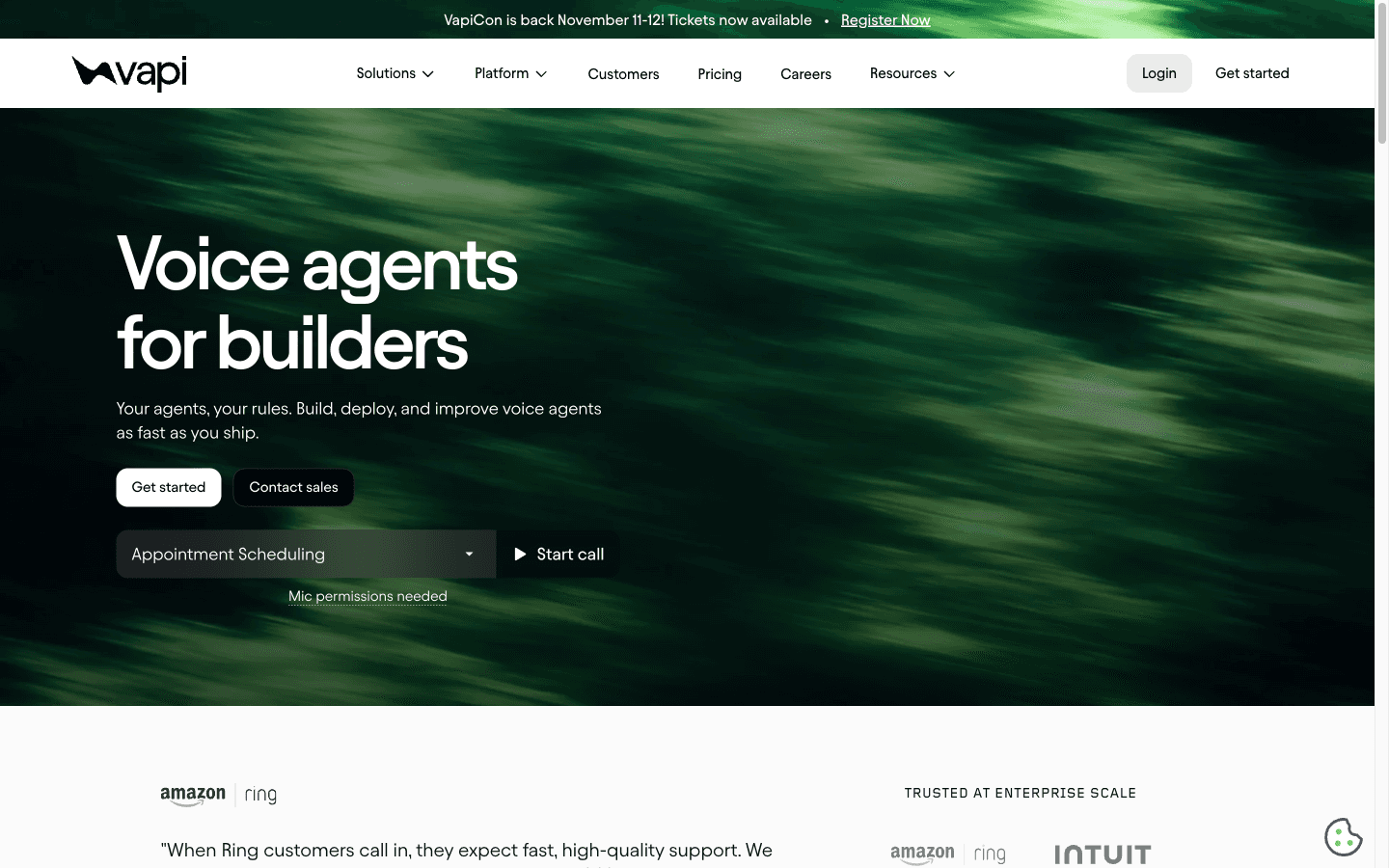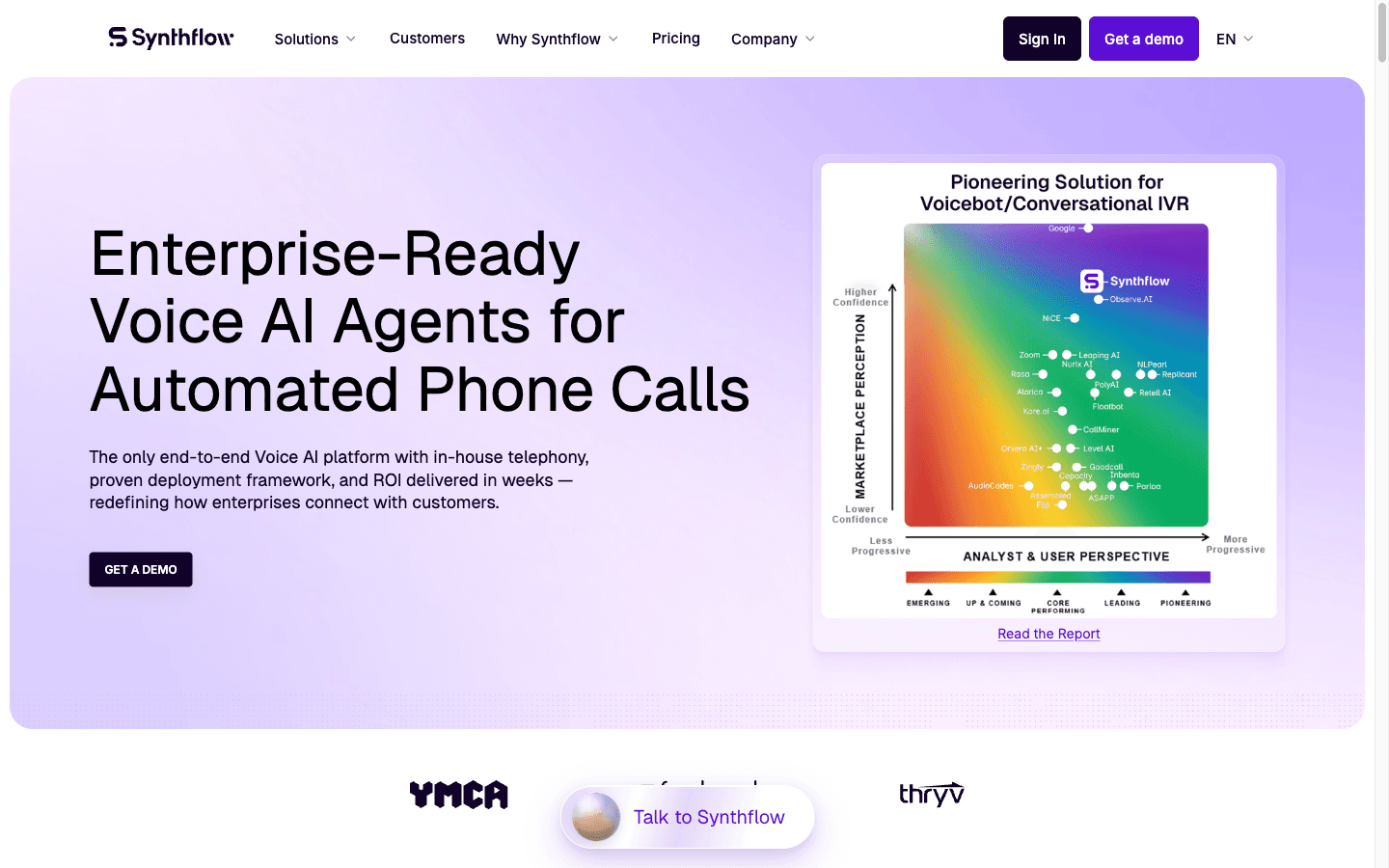
Synthflow AI vs Vapi: No-Code Voice Agents or the Developer Platform? (2026)
Last updated: October 27, 2026 | Method — read this first: this is a research-only comparison. We have not deployed either platform on a live phone line. What we did: read both vendors' pricing pages, documentation, and review profiles on 2026-10-26, and traced every number below to its source. Where a claim is the vendor's own, it says so.
These two platforms answer the same question — "how do I put an AI voice agent on the phone" — from opposite ends of the skill spectrum. Pick wrong and you either pay developer-platform prices for flows a template would have covered, or you fight a no-code builder for control it was never designed to give you.
Quick verdict, for the most common buyer: an agency or small business launching a first voice agent without a developer should start with Synthflow. Building is free, templates cover receptionist-booking-qualification patterns, and the compliance posture (SOC 2, HIPAA, PCI DSS, GDPR claims with region-based hosting) is the part non-technical teams consistently underprice until a client in healthcare or finance asks. The catch is real, though: as of October 2026 the public pricing page opens at a $30,000/yr enterprise plan — a Capterra listing still says "from $29/month" — so you will be extracting real numbers from a sales call. If you have engineers, Vapi is the platform: Core at $29/mo, full API, bring-your-own transcriber, LLM, and voice models, and simulation plus A/B testing included. Its catch is the meter — Vapi's own calculator puts 1,000 minutes a month at $82–129 once you stack all five per-minute costs.
One line if you remember nothing else: Synthflow is operator-first — build free, launch on the platform's rails. Vapi is developer-first — own every model, pay for every millisecond.
What you're actually choosing between
Synthflow sells the shortest path from idea to dial tone. The no-code builder, the template library, and in-house telephony mean a marketing ops person can have an appointment-setting agent answering calls in an afternoon. The review record backs the claim where it matters: across 1,016 G2 reviews (4.5/5), voice quality and latency are the most consistent praises, and "Ease of Use" appears in 364 of them. For an operator, that's the difference between shipping this quarter and staffing a dev project.
Vapi sells the opposite trade. Everything is exposed: thousands of API configurations, your own or self-hosted speech models, tool calling into your backend, test calls before production, A/B experiments on prompts and voices. Two of three G2 reviewers (both 4.5/5) credit fast setup even without deep coding, which tells you the dashboard is usable — but the platform's real audience writes code, versions its prompts, and wants its voice agent in a CI pipeline like any other service.
The choice is less about features than about who maintains the thing at week twelve. A no-code agent breaks when the vendor's template doesn't cover your edge case and nobody on your team can drop to the API. A developer platform "breaks" when your engineer who built it moves on to another company. Both failure modes show up in the review records; neither tool saves you from them.
Head-to-head
| Synthflow AI | Vapi | |
|---|---|---|
| Starting price (verified 2026-10-26) | Free to build; pay per call once launched; public Enterprise tier from $30,000/yr | Core $29/mo + usage ($0.05/min hosting plus model costs) |
| Who builds | No-code: templates, visual flows | Developers: full API, self-host or BYO models |
| Custom models | Platform stack; BYO Twilio locked to Business tier (~4x Pro price per a May 2026 G2 review) | Bring your own or self-host transcriber, LLM, voice |
| Compliance | SOC 2, HIPAA, PCI DSS, GDPR claims; region-based hosting | SOC 2, PCI; HIPAA as paid add-on ($2,000/mo) |
| Testing | Campaign tooling (GoHighLevel flows) | Test calls, A/B on prompts and voices, monitoring on every plan |
| Telephony | In-house; EU numbers not out-of-the-box (US/CA/AU) per May 2026 G2 review | Bring-your-own telephony supported |
| Review record | G2 4.5/5 from 1,016 reviews | G2 thin (3 reviews); Trustpilot complaints on support waits |
The catch on each side
Synthflow's catch: the pricing wall and the cancel trap
The no-code builder is free until you launch — that part is genuinely good. What changed is what happens when you go to pay. As of 2026-10-26, the public pricing page shows a single Enterprise plan starting at $30,000/yr. A Capterra listing still reads "from $29/month," which means third-party price comparisons you'll find are stale, and the real self-serve tiers are only visible in-app or on a sales call. If your budget is three figures a month, you're buying through a funnel, not a pricing page.
The second problem is documented on Trustpilot: repeated reports of billing continuing after cancellation — one April 2026 reviewer says charges ran five months past their cancel date until they blocked the debit card; another resolved it through an American Express chargeback in August 2025. Trustpilot also notes the company hasn't replied to negative reviews. None of this touches call quality. All of it touches the exit, and the exit is the part you can't demo.
Support has its own pattern: "No support" (December 2025), generic AI-sounding replies that don't fix reported bugs (May 2026), and a G2 review noting there's no way to close your account from the dashboard. Individually, anecdotes. Together, a pattern worth pricing in.
Vapi's catch: five meters and a $999 floor
Vapi's per-minute price is not a number, it's a sum: hosting ($0.05/min) plus your transcriber, your LLM, your voice model, and telephony. The vendor's own calculator lands a 1,000-minute month at $82–129. That's honest — the calculator is public — but it means your finance person, not your developer, decides whether the platform is cheap, and the answer changes with every model swap.
The floor is steeper than the headline: Pro requires a $999/mo minimum. And the compliance add-on has a documented pricing incident — a G2 reviewer watched HIPAA double from $1,000 to $2,000/mo overnight with no warning; the current page lists $2,000. Support complaints cluster on both platforms: roughly week-long waits on production issues per one Trustpilot reviewer, three weeks of silence across email and Discord per one G2 reviewer. Config-state bugs (agent settings not persisting, live edits with no save state) appear on Trustpilot. For a dev-first platform, that support record is the weak flank.
What a minute really costs
Synthflow's pay-per-call model prices the same minute differently: you're buying outcomes on the platform's rails, with the model costs bundled and hidden. You can't audit them, and that's partly the point — the buyer is paying for a working call, not compute. The enterprise-first page means the number you get depends on your negotiation. What we can say: building and testing cost nothing, so the evaluation budget is your time.
Vapi's stack pricing is auditable down to the component, which cuts both ways. A lean configuration — cheap transcriber, smaller LLM, standard voice — keeps a 1,000-minute month near the $82 end. A premium stack with a frontier LLM and cloned voice walks toward $129 and beyond, and every rerun of a prompt in testing burns real money. Teams that don't set alerts on usage are the ones who write the angry reviews; the vendor's pricing FAQ effectively says so.
Seat math barely matters on either — Synthflow's tiers gate features and minutes, Vapi's Core-to-Pro jump is about support and minimums. The cost curve is driven by call volume, and volume is exactly what neither pricing page lets you model without talking to someone on Synthflow's side or running your own calculator math on Vapi's.
Where each one wins
Synthflow wins when the builder is not a builder. A real-estate agency that needs missed-call capture and booking, a clinic that needs HIPAA-grade handling, an agency deploying the same receptionist pattern across 20 clients — these are template jobs, and the 1,016-review record says the platform holds up under exactly this load. The GoHighLevel integration keeps coming up in reviews because that's who the buyer is: agencies, not engineers.
Vapi wins when the voice agent is product surface, not a workflow. If the agent must call your own APIs mid-conversation, run against your fine-tuned model, get evaluated in CI before deploy, and be reproduced deterministically in staging — that's Vapi's entire design center. The simulation and A/B tooling on every plan, including free-tier evaluation, is what a team that ships software expects and a no-code tool won't give them.
The EU wrinkle deserves its own sentence: a May 2026 G2 review reports Synthflow's EU phone numbers aren't available out of the box (US/CA/AU only) — if your call volume is European, that's a checkbox Vapi's bring-your-own telephony handles more naturally.
When to use both
It happens more than the vendors would like: an agency standardizes on Synthflow for client-facing deployments that need compliance sign-off and non-technical handoff, while its product team runs Vapi behind the scenes for the flows that need custom models and backend calls. The overlap is small — both are phone agents, but they're bought by different people for different reasons.
What doesn't make sense is running both for the same agent. Migration between them is a rebuild, not an export: templates don't translate to API configurations, and neither vendor advertises an exit path. Decide once, based on who maintains the thing.
What neither one covers
Said plainly, because voice-agent comparisons rarely do: neither is a conversation-intelligence layer (transcription analytics, coaching, CRM notes from human calls — that's a different category we cover in the sales stack), neither handles your outbound compliance obligations (consent laws, DNC lists — that's your process, not the platform's), and neither publishes accuracy benchmarks we could verify independently. Synthflow's "human-like" claims are its own; Vapi's sub-500ms latency claim is its own, with one mid-market G2 reviewer corroborating the feel. Treat both as vendor claims.
Final verdict
If you're an agency or SMB without a developer, start in Synthflow's free builder and don't leave it until you've booked a real appointment through a template agent. Then take the sales call with your volume in hand — and calendar the cancellation terms before you enter a card. If you have engineers and the agent touches your own systems, Vapi's Core tier and calculator will tell you in an hour whether the per-minute math works at your volume; set usage alerts on day one.
The platform you outgrow is cheaper than the platform you can't maintain. Pick for the team you actually have.
FAQ
Is Synthflow cheaper than Vapi?
At low volume, Synthflow's build-free, pay-per-call model is cheaper to start, and there's no monthly floor. Vapi's Core package is $29/mo plus usage, and Pro starts at a $999/mo minimum. But Synthflow's self-serve tiers are no longer publicly priced (the public page opens at $30,000/yr as of October 2026), so the honest answer is: request both quotes at your real volume.
Can you build a voice agent on Synthflow without coding?
Yes — that's the product's core. Templates, visual flows, and in-house telephony are aimed at operators, and ease of use is the most-tagged theme in its 1,016 G2 reviews (364 mentions). You build free and pay when the agent starts taking calls.
How much does Vapi cost per 1,000 minutes?
Vapi's own calculator puts it at $82–129/month depending on your model stack: $0.05/min hosting plus separate transcriber, LLM, voice, and telephony charges. The Core package ($29/mo) is the entry; Pro carries a $999/mo minimum.
Which voice AI platform is HIPAA compliant?
Both claim HIPAA coverage, differently: Synthflow bundles HIPAA-grade compliance with region-based hosting in its platform claims; Vapi sells HIPAA as a paid add-on currently listed at $2,000/mo — a price a G2 reviewer documents doubling from $1,000 overnight in 2026. If healthcare calls are your use case, get the compliance terms in writing before committing to either.
Can I migrate from Synthflow to Vapi later?
Not as an export — you'd rebuild the agent as API configurations. That asymmetry is worth weighing at the start: Synthflow's no-code speed is also its lock-in, and Vapi's configurations are at least portable to your own code if you ever leave.
Disclosure: This page contains affiliate links. Synthflow AI and Vapi both run active affiliate programs (20% recurring via Tolt per network data verified 2026-10-27). Pricing was verified from vendor pages on 2026-10-26 and can change; where pricing isn't public, we said so. We also recommend tools with no affiliate program when they're the best fit.
Update log: 2026-10-27 — published with October 2026 pricing and review-record verification.