
Affiliate disclosure: Some links below may earn us a commission at no cost to you.

Typefully
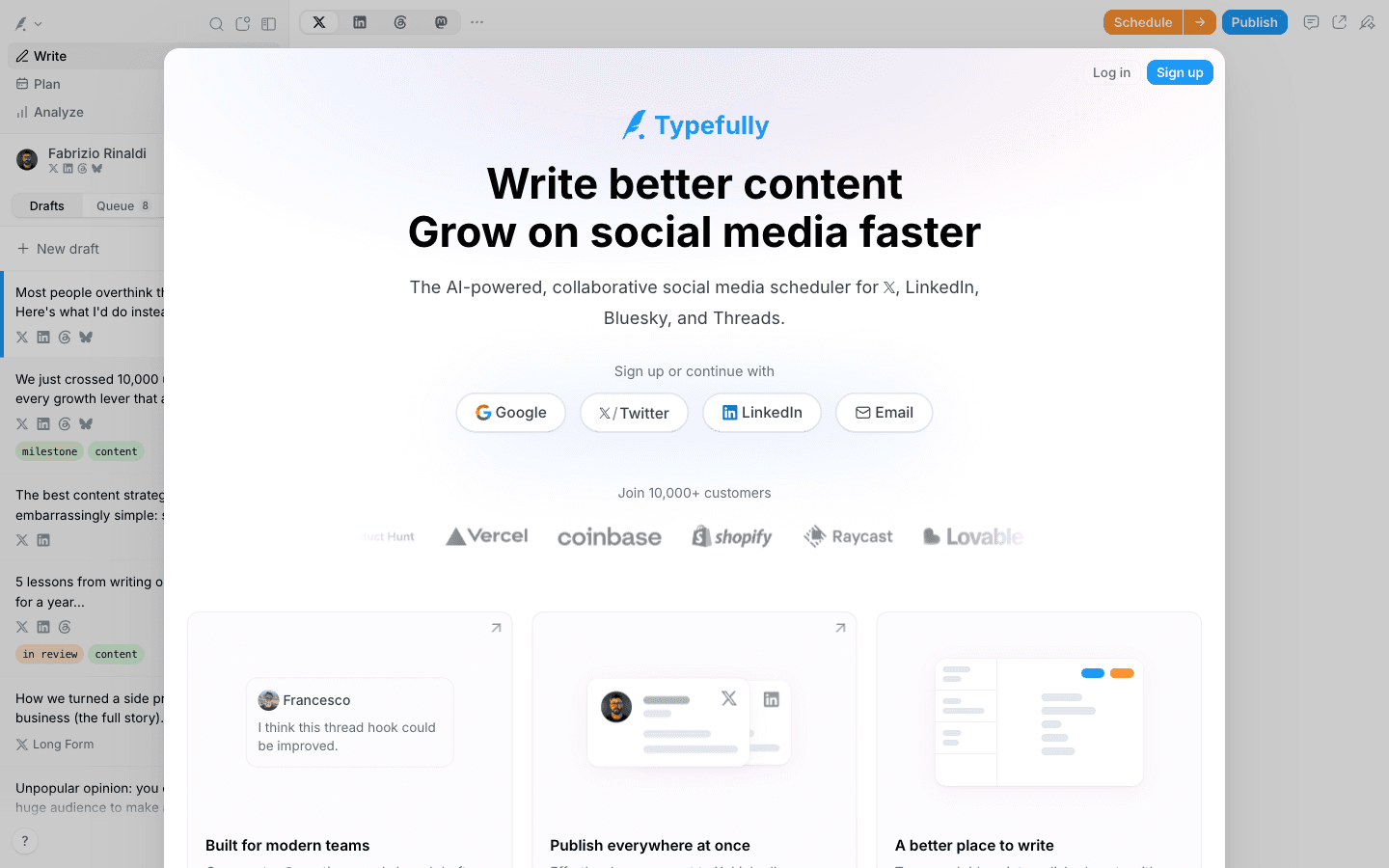
The AI-powered, collaborative social media scheduler for X, LinkedIn, Bluesky, and Threads.
$0/mo (Free, 10 posts); Creator $99/yr
Try Typefully Full review →
Typeshare
Write and publish everywhere — AI agents for X, LinkedIn, and Substack, built on a Digital Brain and 500+ writing templates.
$0 (Free plan); Pro ~$20/mo (third-party, verify in app)
Try Typeshare Full review →Our pick
Typefully
Best for Solo creators and small teams who write elsewhere and need reliable multi-network scheduling, X growth automations, and agent-friendly API/MCP access — from $0 (10 posts/mo) to $99/year Creator.
Creators whose bottleneck is distribution should buy Typefully: $99/year (about $8.25/month) puts a week of drafts into a queue that publishes across five text networks with auto re-promotion, and the free tier proves it with 10 posts a month plus API access. Writers whose bottleneck is starting should buy Typeshare: the idea bank plus format-specific agents plus template structure solves the blank page, and the free plan supports a daily writing habit indefinitely. Typefully documents real gaps — X-only analytics and annual-only billing; Typeshare documents none at all, which is its own kind of risk: zero independent reviews and a price you can only see behind a signup.
Feature comparison
| Feature | Typefully | Typeshare | Winner |
|---|---|---|---|
| Starting price (verified Oct 2026) | $0 (10 posts/mo); Creator $99/year, annual-only | $0 (10 idea generations/day); Pro ~$20/mo, third-party tracked | — |
| Primary job | Queue, schedule, and re-promote posts across networks | Idea storage and platform-native drafting from templates | — |
| Platforms covered | X, LinkedIn, Bluesky, Threads, Mastodon (+ Substack in plan compare) | X, LinkedIn, Medium, Substack Notes, public Typeshare profile | — |
| Analytics | X only — LinkedIn/Bluesky/Threads get no numbers back | Cross-network performance scores; no third-party review record to corroborate | — |
| AI features | AI rewriting, AI chat, alt-text on paid plans; MCP server + agent skills | Four format agents (X, LinkedIn, Substack, Designer) + Digital Brain idea engine | — |
| Templates | None — bring your own drafting workflow | 500+ descended from the Ship 30 for 30 canon | — |
| Team features | Business: comments, roles, Slack notifications ($18/mo per social set) | No evidence of team seats or shared workflows | — |
| The documented catch | Annual-only paid billing, no refund policy page in its own sitemap, one 0.5/5 G2 review describing lost AI credits | Signup-wall pricing, template-driven output convergence, zero G2/Trustpilot reviews | — |
Side-by-side deep dive
What it does best
- Real free tier: $0 gets you 10 posts a month, advanced scheduling, and even API/MCP access — enough to run a personal queue without paying (pricing page, 2026-10-27).
- One draft publishes to X, LinkedIn, Bluesky, Threads, and Mastodon, with Substack appearing in the plan comparison — coverage of the text-first networks most suites treat as afterthoughts (pricing compare, 2026-10-27).
- Creator costs $99/year — about $8.25/month for AI rewriting, X analytics, and unlimited media, roughly a tenth of what full management suites charge for the same posting volume (pricing page, 2026-10-27).
- The only scheduler in our category shipping an MCP server and agent skills, so Claude or ChatGPT can queue drafts into your calendar directly (homepage + pricing compare, 2026-10-27).
The catch
- Analytics exist for X only — LinkedIn, Bluesky, and Threads get your posts but no numbers back, a gap a third-party hands-on reviewer hit directly in September 2026 (blog-everydayaituts, updated 2026-09-18).
- Creator is annual billing only: $99 up front, no monthly option, and the /refunds URL listed in Typefully's own sitemap redirects to the homepage instead of a policy (verified 2026-10-27).
- AI usage burns credits, and the single G2 review (0.5/5, March 2026) describes losing a full day of credits correcting a brand voice the AI fabricated (G2, accessed 2026-10-27).
What it does best
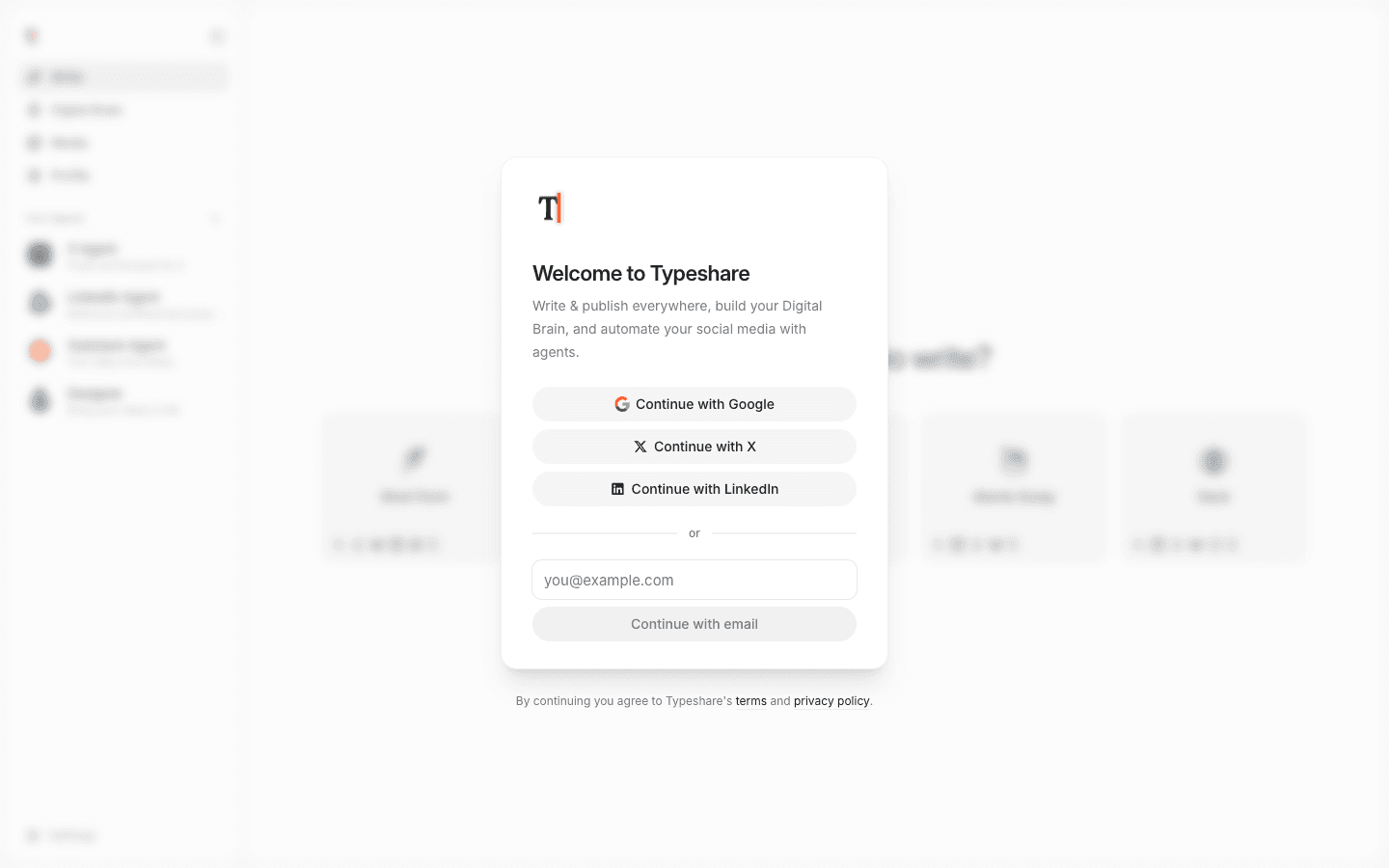
- Four purpose-built agents on the app menu — X Agent for posts and threads, LinkedIn Agent for professional presence, Substack Agent for Notes, and a Designer for visuals — cover the exact formats daily writers produce (app signup screen, 2026-10-27).
- The idea pipeline is real: 10 daily idea generations on free, unlimited on Pro, feeding a Digital Brain so concepts survive between writing sessions (Toolradar, Oct 2026 + app screen).
- 500+ templates descend from the Ship 30 for 30 playbook — hooks, essays, listicles — which is why the tool works for beginners who need structure more than they need freedom (Toolradar + CreatorEconomyTools, accessed 2026-10-27).
- A genuinely useful free plan: social blog publishing, streak tracking, and up to 5 collections at $0 — enough to test the habit loop before paying (Toolradar, Oct 2026).
The catch
- There is no public pricing page — typeshare.co/pricing 404s, the homepage is a signup wall, and you must create an account before seeing a number; the ~$20/month figure is third-party, not vendor-published (checked 2026-10-27).
- Template-driven writing converges: reviewers note output can sound like every other Typeshare user, drifting marketing-heavy — a real cost when your audience reads multiple writers trained on the same templates (CreatorEconomyTools, accessed 2026-10-27).
- For a single-purpose writing editor it's priced high: if you bring your own process and skip the idea engine, $20/month competes with Ghost at $18 or a free Medium/Substack stack (Toolradar comparison table, Oct 2026).
Pricing showdown
| Plan | Typefully | Typeshare |
|---|---|---|
| Free plan | Yes | Yes |
| Pricing type | freemium | freemium |
| Starting price | $0/mo (Free, 10 posts); Creator $99/yr | $0 (Free plan); Pro ~$20/mo (third-party, verify in app) |
| Enterprise | Custom | Custom |
Use-case matching
Choose Typefully if...
- Solo creators and small teams who write elsewhere and need reliable multi-network scheduling
- X growth automations
- and agent-friendly API/MCP access — from $0 (10 posts/mo) to $99/year Creator.
Choose Typeshare if...
- Daily writers building an X/LinkedIn/Substack habit who want idea storage
- format-native AI drafting
- and template structure — free for 10 idea generations/day
- Pro around $20/mo (third-party tracked).
Final verdict
Our pick: Typefully
Creators whose bottleneck is distribution should buy Typefully: $99/year (about $8.25/month) puts a week of drafts into a queue that publishes across five text networks with auto re-promotion, and the free tier proves it with 10 posts a month plus API access. Writers whose bottleneck is starting should buy Typeshare: the idea bank plus format-specific agents plus template structure solves the blank page, and the free plan supports a daily writing habit indefinitely. Typefully documents real gaps — X-only analytics and annual-only billing; Typeshare documents none at all, which is its own kind of risk: zero independent reviews and a price you can only see behind a signup.
Full comparison
Method
Researched from both vendors’ pricing pages, feature pages, and the public review record, verified 2026-10-27. Typeshare’s pricing is flagged wherever third-party: the vendor publishes no pricing page, and this comparison does not dress that number up as official.
Quick verdict
A creator whose problem is shipping to enough networks should buy Typefully: $99/year queues one draft out to X, LinkedIn, Bluesky, Threads, and Mastodon with previews and auto re-promotion, and the free tier proves the loop with 10 posts a month before any card comes out. A writer whose problem is starting should buy Typeshare: the Digital Brain keeps ideas alive between sessions and the format agents turn them into X threads, LinkedIn posts, and Substack Notes without a blank page in sight — free at 10 idea generations a day. Typefully’s trade is documented in its own sitemap: X-only analytics and annual-only billing with a /refunds URL that redirects home. Typeshare’s trade is silence: no public price, no independent reviews, and template-trained output that can converge with every other writer on the platform.
The catch on each side
Typefully’s catch is commitment plus blind spots. Creator is annual-only at $99 up front; the /refunds URL listed in its own sitemap redirects to the homepage instead of a policy; analytics return numbers for X only (a gap a September 2026 hands-on reviewer hit directly); and the single G2 review (0.5/5, March 2026) describes losing a full day of AI credits correcting a brand voice the AI fabricated. No inbox, no listening, no client reporting — agencies still need a management suite.
Typeshare’s catch is verification debt. You cannot see a price without creating an account, the ~$20/month figure is third-party, output trained on 500+ shared templates can drift marketing-heavy and converge with other users’ voices, and the independent record is empty — zero G2 reviews on an unclaimed profile, no Trustpilot page. At $20/month for a single-writer editor, it also competes with Ghost at $18 for writers who bring their own process.
When to use both
They chain cleanly because they own different stages: draft platform-native pieces in Typeshare from the idea bank, then queue the week through Typefully across five networks with Auto-Plug re-promoting evergreen posts. The combined bill runs about $28/month amortized. The overlap to police is AI drafting — if both tools draft, your voice splits; make Typeshare the drafting home and Typefully the editing-and-scheduling layer.
The one-liner
Typefully is schedule-first; Typeshare is draft-first — and the annual-billing page versus the signup wall is each vendor telling you which problem it thinks you have.
Full breakdowns: Typefully · Typeshare · the workflow this pairing powers: 1 Blog Post → 15 Social Pieces.
Frequently asked questions
Is Typefully free plan enough for scheduling?
How much does Typeshare cost?
Which tool is better for LinkedIn?
Can you use Typefully and Typeshare together?
Which tool has better AI rewriting?
Evaluated by workflow fit, output quality, and pricing transparency. How we review →