Best AI Agent Builders 2026: 3 Platforms Compared (Plus When to Use a Framework)
Last Updated: October 27, 2026 Method: Research-only. Every price below was verified against vendor pages on October 26–27, 2026. This is the smallest category in our directory — three published platforms — and we'd rather ship a focused, honest comparison than pad it with tools we haven't verified. Judgments come from the documented record — vendor specs, pricing mechanics, Trustpilot, G2 — not from our own agent deployments. Commission figures in the disclosure come from affiliate signup pages pulled the same week.
The honest headline for this category: "best AI agent builders" is a 2.4K-searches-a-month question with barely three verified commercial answers. The agent-platform market is real and growing fast, but almost everything in it is either a code framework (free, hard), a sales-gated enterprise platform (undocumented), or a brand-new credit-metered startup (unproven). "How to build an AI agent" pulls 2.9K searches a month at KD 65 — people want to build — and "best ai agents" adds 1.3K at KD 49. Our directory covers this category with three published platforms, each attacking a different slice of the problem. This guide compares them and tells you plainly when none of them is the answer.
Quick answer: for AI agencies building client agents at volume, BuildMyAgent ($25/mo to start, unlimited agents, white-label at Scale) is the credit-platform pick — with the newest, thinnest track record on this list. For enterprises deploying agent workforces with evaluations and SOC 2 plumbing, Relevance AI is the pick — with public pricing gone (sales-gated; G2's stale listing said $199/mo). For no-code voice agents with in-house telephony and HIPAA-grade compliance, SynthFlow AI is free to build and pay-per-call at launch — with public pricing now starting at $30,000/yr contracts. And if you'd rather write the loop yourself, skip all three: LangGraph, CrewAI, and the OpenAI Agents SDK are free frameworks, and Vapi (~$0.05/min) is the developer API behind voice agents.
One line worth keeping: the agent-builder market in 2026 sells the same thing at three price points — a demo for $25, a workforce for "talk to sales," and a phone line that bills by the minute — and which one you need depends entirely on who maintains it after launch.
What "AI agent builder" actually means in 2026
three different products share the label — no-code platforms where you configure an agent's tools and knowledge (BuildMyAgent, Relevance AI), vertical agent products where the loop is fixed and the job is voice (SynthFlow), and code frameworks where you write the loop yourself (LangGraph, CrewAI, OpenAI Agents SDK). Knowing which one you're shopping for is the whole decision, because they don't overlap on price, skills, or exit paths.
The no-code platforms sell time-to-agent: connect your knowledge, pick tools, deploy a bot that takes actions — chat with customers, qualify leads, run workflows — without an engineering team. The vertical products bake the loop in: SynthFlow's voice agents answer, schedule, and hand off on phone calls, and you configure rather than construct. The frameworks are the opposite trade: free and maximally flexible, with the maintenance contract written in your own engineering time. "How to build an AI agent" searches split exactly along this line, and the variant data says it out loud — "how to build an ai agent replit" (1.0K/mo) is the framework path, while this article's three platforms are the configured path.
One more honesty note before the comparisons: this is the smallest category in our directory, and per our method we feature only what we've verified. Three platforms, one developer API, and the frameworks — that's the real field as of October 2026, not a top-10 list padded with landing pages.
BuildMyAgent: the agency play, priced in credits
BuildMyAgent is built for AI agencies reselling agents to clients — unlimited agents on every tier, client sub-accounts, white-label at Scale, from $25/mo in credits. The catch: per-action billing is opaque, the annual discount toggle doesn't show prices, and there is no independent review record at all.
BuildMyAgent prices like an agency tool because it is one: Starter is $25/mo for 500 credits, unlimited agents, and 1 sub-account ("for the first client," in the vendor's own words); Growth is $79/mo for 3,000 credits and 5 sub-accounts with marketplace access — advertised at 75% off the first month ($19.75, then $79); Scale is $297/mo for 10,000 credits, unlimited sub-accounts, and white-labeled client accounts and demos; Enterprise is $2,000+/mo with bulk credit deals and white-glove onboarding. There's no free plan or trial listed anywhere on the pricing page or FAQ — the $25 entry is the test. The catch stack: credits meter per action (the per-action cost isn't published — a demo-heavy build phase burns credits you can't predict), the annual toggle advertises −40% but showed no tier prices in two verification passes, and as of October 2026 we found no Trustpilot, G2, or meaningful Product Hunt record. The 40% recurring affiliate commission is the highest we've verified in any category this quarter — enjoy the disclosure, and weight it accordingly when you see this tool recommended. The product thesis is genuinely interesting for agencies (white-labeled client accounts are rare at this price); verify it monthly-billed against one real client before scaling.
Relevance AI: the enterprise workforce, behind the sales wall
Relevance AI is the most enterprise-credible platform here — built-in agent evaluations, A/B testing, SSO/RBAC, 2,000+ integrations, calling and meeting agents — and the least priceable: public pricing has been replaced by a single "Talk to sales" Enterprise card. G2's stale vendor-provided listing said Free / Team $199/mo / Business $599/mo; treat that as a lead, not a quote.
Relevance AI sells an "AI workforce": no-code agent builder, unlimited agents and tools on Enterprise, custom vendor credits, 2,000+ integrations, calling and meeting agents, and — the detail that separates it from startup platforms — agent evaluations and A/B testing built in, plus SSO, RBAC, and audit logs. The pricing story needs a straight retelling: the current pricing page is one Enterprise card with custom credits and a sales CTA — no tiers, no free trial mention, no credit-card note (a "Try for free" entry point exists on the product pages, details undocumented). G2 and Capterra still carry vendor-supplied numbers (Team $199/mo, Business $599/mo; Capterra "from $199") that no longer appear on the vendor's own site — we report them as stale leads, not prices. The catches: refund policy is hard-line per our verification notes, the sales-gated path means your price depends on your negotiator, and the evaluation tooling — the real differentiator — can't be assessed from a pricing page at all. For a mid-size company deploying agents that touch customer data, the eval-plus-governance stack justifies a sales call; for everyone else, the opacity is the answer.
SynthFlow AI: voice agents, free to build, enterprise to scale
SynthFlow is the no-code voice agent platform — in-house telephony, HIPAA-grade compliance, free to build with pay-as-you-go per call at launch. The catch is the pivot: public self-serve tiers are gone, and the pricing page now opens at $30,000/year enterprise contracts.
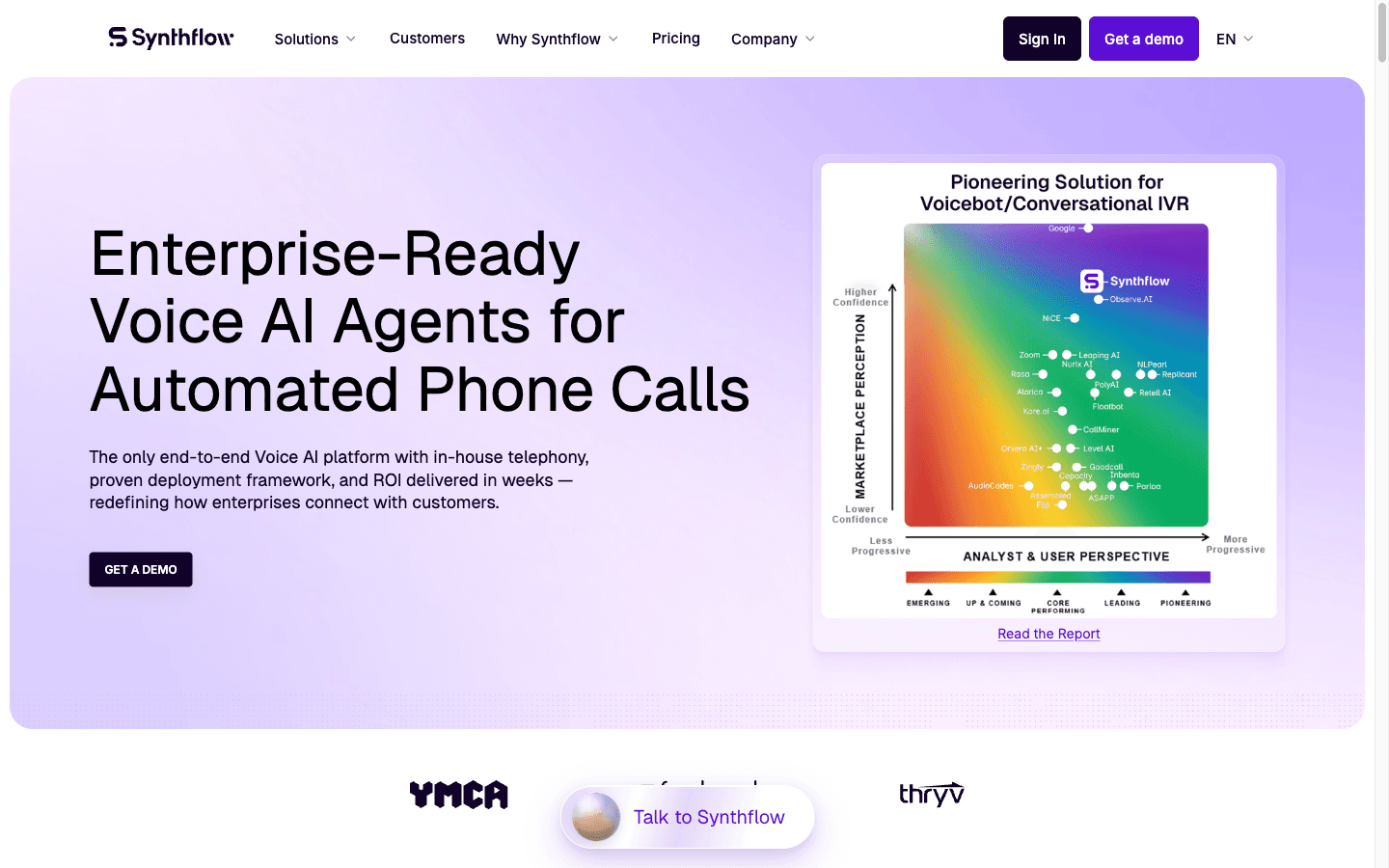
SynthFlow AI builds phone-handling voice agents: templates or from scratch, no code, calls that book appointments, answer FAQs, and transfer to humans — with telephony owned in-house rather than rented, and compliance positioning (HIPAA-grade) aimed at clinics and service businesses. The economics per the vendor's own FAQ: building an agent is free, and you pay per actual call and chat once it's live. But the self-serve ladder has disappeared from the pricing page — as of our October 2026 verification it shows exactly one card: Enterprise, "contracts start at $30,000 annually," scoped by call volume, concurrency, telephony setup, integrations, and launch support. Capterra still lists "from $29/mo" — stale. A May 2026 G2 review (one star, single source, so we hedge) describes Pro and Business tiers inside the app, with bring-your-own Twilio locked behind Business at roughly 4× Pro's price, and notes that test calls burn credit minutes. The catches, then: the cheap on-ramp may still exist in-app but is no longer documented, testing isn't free, and the affiliate program has a documented complaint of an approved $10,840 commission deleted without explanation — timing and tracking evidence matter if you refer. For a clinic chain or multi-location service business that lives on phone calls, the compliance-plus-telephony stack is the product; for a solo operator, call the sales line and ask what a small deployment actually costs before assuming anything from old directory listings.
The framework answer: when to skip all three
if you have an engineer who'll own the system, the free frameworks beat every platform on cost and control — LangGraph and CrewAI for orchestration, the OpenAI Agents SDK for OpenAI-stack teams, Replit's agent tooling for the build-in-browser path (1.0K searches/month say we're not alone in pointing there). We recommend them with no affiliate link because they're free; the cost is engineering time and the maintenance contract is yours.
The crossover math is simple enough to write down. A platform subscription ($25–297/mo at BuildMyAgent's tiers) buys you hosting, tool connectors, and a dashboard — worth it when nobody on your team wants to own deployment. A framework buys you full control of the loop, model choice, and zero metered credits — worth it when agent behavior IS the product and an engineer can own uptime. The failure mode runs in both directions: teams paying platform fees for an agent their engineer could ship in a weekend, and teams hand-rolling infrastructure their ops person needed as a dashboard. Voice is the special case — the framework path still needs telephony, ASR, and TTS plumbing, which is exactly what the developer API Vapi sells (~$0.05/min hosting plus provider costs, from our AI coding tools roundup); code the loop on a framework, rent the phone layer. And if your "agent" is really a docs-chatbot for support, that's a cheaper, more mature purchase entirely — see Best AI Customer Service Tools before buying an agent platform to answer "where's my order."
What agent building actually costs
from $0 (frameworks, your time) to $30,000/year (SynthFlow enterprise) — the spread in this category is wider than any other we cover, because you're choosing between buying software and building it. Verified October 2026:
| Path | Tool | Cost shape |
|---|---|---|
| Code it yourself | LangGraph / CrewAI / OpenAI Agents SDK | $0 software + engineering time + model API costs |
| Code the loop, rent the phone layer | Vapi | $29/mo Core + ~$0.05–0.14/min all-in |
| Agency reselling agents | BuildMyAgent | $25–297/mo credits, opaque per-action |
| Enterprise workforce | Relevance AI | Sales-quoted; stale G2 listing said $199/mo |
| Voice at business scale | SynthFlow AI | Free build; PAYG per call; enterprise from $30K/yr |
The honest reading of that table: the price rows aren't comparable, and that's the point. The $25 row and the $30,000 row are different purchases wearing one category label. Budget the maintenance owner first — the platform fee is never the whole cost, and neither is the framework's "free."
Where agent building still breaks in 2026
the failure modes are unmetered action costs, demo-to-production gaps, and evaluation debt — agents that work in demos and drift in production. Four specifics from this category's verified record.
- Per-action billing is the invisible invoice. BuildMyAgent meters credits per action without publishing per-action costs; SynthFlow burns minutes on test calls. Whatever platform you pick, run a 50-action test script on day one and divide credits burned by actions taken — that quotient, not the tier price, is your unit cost.
- Demos are free for a reason. Every platform here demos beautifully; the documented gaps are between demo and production — Relevance's evaluations exist precisely because unmonitored agents drift, and its absence is what you're accepting when you buy a cheaper platform. Ask any vendor one question before signing: "show me the eval tooling."
- Public pricing is evaporating. Relevance AI and SynthFlow both removed self-serve pricing within the last year; directory listings (including stale G2/Capterra data) still quote the old numbers — including ours until re-verified. Treat any agent-platform price older than a quarter as a rumor, including the ones in this article (dated October 27, 2026, so you can judge).
- The exit matters more here than anywhere. An agent configured on a platform is portable only if the platform exports its loop. Before building on any of the three, ask where the configuration lives when you leave — the frameworks' biggest advantage isn't the $0, it's that the loop is already yours.
Decision framework
| Your situation | Pick | Cost shape | The catch that decides |
|---|---|---|---|
| Engineer on team, agent is the product | LangGraph / CrewAI / OpenAI Agents SDK | $0 + time | You own uptime, evals, and 3am |
| Engineer + voice agent | Vapi + framework | $29/mo + per-minute | 5-line-item meter; rough support record |
| AI agency, client agents at volume | BuildMyAgent | $25–297/mo credits | Opaque per-action costs; zero reviews; monthly-bill first |
| Enterprise, customer-data agents | Relevance AI | Sales-quoted | No public pricing; hard-line refunds |
| Clinic/service business, phone-first | SynthFlow AI | Free build; PAYG; $30K/yr enterprise | Self-serve tiers undocumented; test calls bill |
| Just need docs Q&A for support | Any of: Chatwith, Wonderchat | $9–33/mo | Don't buy an agent platform for a chatbot's job |
FAQ
What is the best AI agent builder in 2026?
There is no single best — the category splits by who maintains the agent. BuildMyAgent ($25–297/mo) for AI agencies reselling white-labeled client agents, Relevance AI (sales-quoted) for enterprises needing built-in evaluations and governance, SynthFlow AI (free to build, enterprise from $30K/yr) for no-code voice agents, and free frameworks (LangGraph, CrewAI, OpenAI Agents SDK) when an engineer can own the loop. We compare three verified platforms because that's the honest size of the verified commercial field in October 2026, not a padded top-10.
How much does it cost to build an AI agent?
Three real price points, verified October 2026: free plus engineering time on open frameworks (LangGraph, CrewAI) with model API costs on top; $25–297/month on no-code platforms like BuildMyAgent, where per-action credit costs are the hidden variable; and sales-quoted enterprise contracts — Relevance AI (undocumented) and SynthFlow AI (from $30,000/year). The number that matters isn't the tier: it's your unit cost per agent action, which you only learn by running a test script and dividing credits by actions.
How do I build an AI agent without coding?
Pick a no-code platform and configure rather than construct: connect knowledge sources, choose tools, set the loop's boundaries, and deploy — BuildMyAgent does this for client-facing agents from $25/mo, SynthFlow for voice agents free-then-per-call, Relevance AI for enterprise workforces through their sales process. The realistic caveats: no-code still means configuring memory, tools, and failure behavior, and the platforms meter by action — budget a test phase where mistakes are cheap. If the agent touches customers by phone, SynthFlow's in-house telephony is the fastest no-code path.
Which AI agent platform is best for agencies?
BuildMyAgent is the only verified platform built for the agency model: unlimited agents on every tier, client sub-accounts from Starter ($25/mo), and white-labeled sub-accounts and demos at Scale ($297/mo) — pricing the reseller relationship directly. The caveats are real (no public per-action costs, no independent reviews yet, highest affiliate commission we've verified this quarter), so the working advice: run one real client monthly-billed before moving your roster. Relevance AI serves agencies too, but its sales-gated pricing suits larger, fewer deployments.
What's the difference between an AI agent and a chatbot?
A chatbot answers from content; an agent takes actions toward a goal — checking orders, booking calls, executing workflows across tools. Chatbots meter in replies and cost $9–33/month (see Best AI Customer Service Tools); agents meter in actions and run $25/month to $30K/year depending on platform. The 2026 overlap is real — support bots with API access blur the line — but the buying test holds: if your system only ever needs to answer, buy the chatbot; the moment it must do, you're shopping in this category.
Are AI agents worth it for small businesses?
For phone-heavy service businesses (clinics, salons, home services), voice agents like SynthFlow are the strongest verified case — missed calls are direct revenue loss, and pay-per-call pricing scales with use. For most other small businesses, the honest answer is a chatbot plus automation (a $9–50/month stack) covers the actual need, and an agent platform is complexity without a job. Build the boring version first; the agent decision gets easy once you know which repeated action you'd actually hand to software.
Related Guides
- Best AI Customer Service Tools (2026) — the chatbot layer most "agent" projects actually need
- Best AI Coding Tools (2026) — the developer stack, including Vapi's voice API
- Best AI Automation Tools (2026) — deterministic workflows vs agentic loops
- AI Tool Comparisons Hub — every head-to-head on the site
- Browse all AI agents tools in the directory
Last updated: October 27, 2026. Pricing verified October 26–27, 2026 from vendor pages; ratings reflect documented strengths and failure modes from our full tool pages, not hands-on agent deployments. This category's public pricing moves quarterly — treat older numbers anywhere (including directories) as stale until re-verified.
Disclosure: This article contains affiliate links. All three platforms above have active affiliate programs, with commissions verified from signup pages October 2026: BuildMyAgent 40% recurring (the highest we've verified — disclosed so you can weight recommendations accordingly), Relevance AI 15% (first 12 months), SynthFlow AI 20% recurring per data.json (15 months, Growth-plan referrals — partially verified; note a documented complaint of an approved commission being deleted without explanation). Frameworks and Vapi's competitors are recommended with no affiliate link. Vapi's own program paid 15% per paid referral at verification. We also recommend tools with no affiliate program when they're the best fit. Pricing can change — verify at checkout.