Best AI Automation Tools 2026: 10 Tools Sorted by the Job They Automate
Last Updated: October 27, 2026 Method: Research-only. Every price below was verified against vendor pricing pages on October 26–27, 2026, including both billing toggles wherever the vendor showed them. We have not run client automations on these platforms; the judgments come from the documented record — vendor specs, pricing mechanics, Trustpilot, G2 — not from our own runs. Commission figures in the disclosure come from affiliate signup pages we pulled the same week.
"Best AI automation tool" is a question that hides about five questions, because the category sold as one shelf is actually several jobs wearing one label. Pulling data off the web is not building an internal admin panel, is not turning a spreadsheet into an app, is not posting your RSS feed to twelve networks while you sleep. Tools that share an "automation" category page share almost nothing else — and they meter in completely different units: compute hours, requests, seats, posts, guides.
So this guide is sorted by job, not by rank. All ten tools below have full review pages on BestAIStack with pricing verified October 2026; this is the map of which one to open first, what the sticker doesn't say, and where each one breaks.
Quick answer: for web data at any real volume, Apify ($19/mo plus usage) is the working default — a marketplace of 99,000+ ready-made scrapers with a genuinely free $5/month tier. If the job is gluing SaaS apps together without a backend, NoCodeAPI ($12/mo) turns Sheets, Airtable, and 50+ apps into secure endpoints. If the job is an internal admin panel your team logs into, Jet Admin ($16/mo yearly) prompts one into existence on your own database. Teable ($13/seat/mo) is the spreadsheet that grows into an app; SearchApi ($40/mo) is the SERP data layer; Glitter AI ($249/mo — read that number twice) turns a screen recording into a written SOP. For distribution, Nuelink ($16/mo yearly) is the feed-driven scheduler with the healthiest review record, Postpone owns Reddit, and Ocoya writes and schedules — with a Trustpilot score you need to see before your card does. Typedesk ($60/user/yr) automates the typing itself.
One line worth keeping: in 2026, an automation tool's real price is its meter — find the unit it counts (runs, requests, seats, posts) and you've found your actual invoice.
Web data and scraping: the heavy machinery
Apify is the default for web data at volume — free to test, $19/mo to work with, and priced in compute units plus per-Actor fees that reward planning over tinkering. It's the only tool in this list where the free tier is a real production input, not a demo.
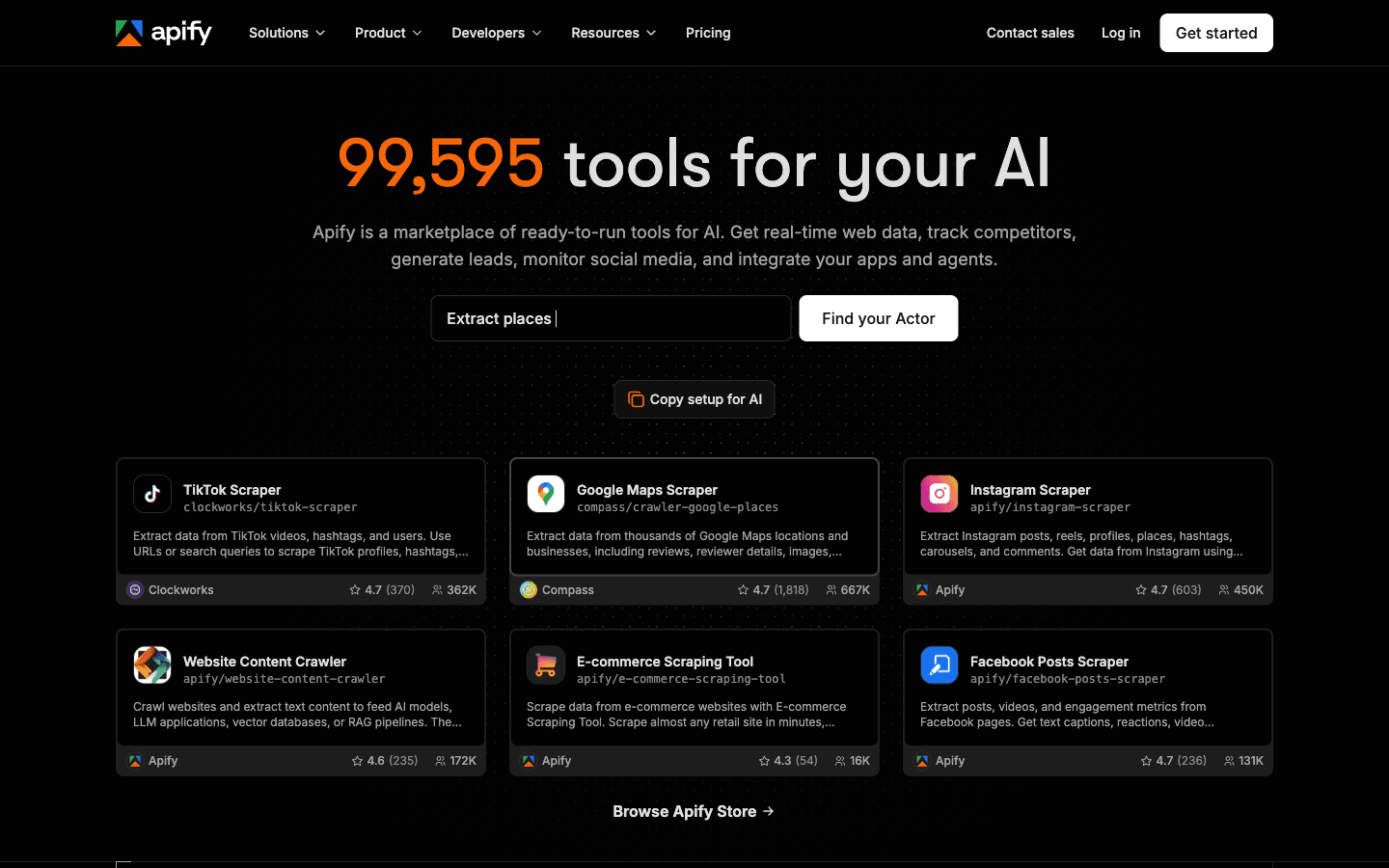
Apify is a marketplace of 99,595 ready-to-run Actors (the count on the homepage the day we checked — it moves daily): Google Maps scrapers with 667K users, Instagram and TikTok scrapers, SERP scrapers, plus the platform to run your own JavaScript or Python serverless jobs on a schedule. Free tier gives $5/month of prepaid usage with no card; Starter is $19/mo plus pay-as-you-go at $0.20 per compute unit (1 CU = 1 GB RAM for 1 hour); Scale is $199/mo at $0.16/CU; Business is $999/mo at $0.13/CU. Annual billing knocks 10% off. Review reputation is the strongest here: Trustpilot 4.8 from 823 reviews (90% five-star), G2 4.7 from 685. The catch is the meter stack: plan + Actor fee + compute units + proxies (residential starts at $8/GB) + storage each bill separately, and G2's two biggest complaint tags are literally "Pricing Issues" (88 mentions) and "Expensive" (87). Also note the G2 pricing widget still shows Starter at $29 — stale against the $19 on the site the same week; we used the site. Budget 2–3 test runs before you trust any cost projection, and read the proxy line item before you scrape anything behind a login.
Internal tools and admin panels: prompt-to-CRUD
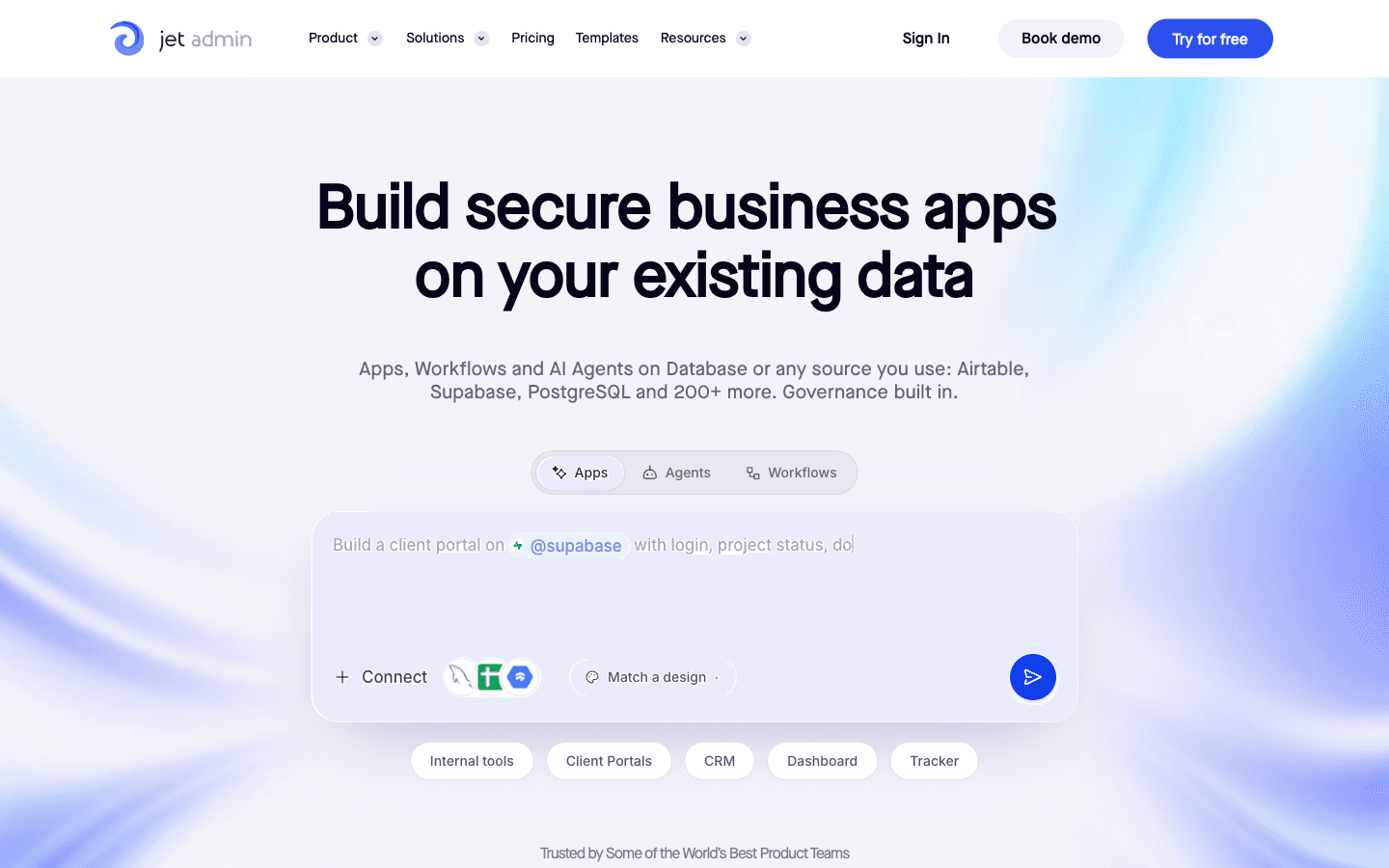
Jet Admin at $16/mo yearly is the cheapest credible way to give a team a real admin panel on top of your own database, with unlimited apps and users on every tier — the AI credits are the only meter. It's a better fit than hiring, and a worse fit than code if governance gets serious.
Jet Admin does the thing every 2023 demo promised: you describe the internal tool, it builds the CRUD app on your Postgres/MySQL/REST data, and your ops team actually uses it. The free plan includes unlimited apps and workflows with limited AI credits; Pro is $16/mo billed yearly ($20 monthly) with custom domain, 2-way GitHub sync, environments, and API access; Business is $80/mo ($100 monthly) with SSO, granular permissions, audit logs, and a 99.9% SLA. The catch is trust surface, not capability: the independent review record is close to nonexistent — G2 4.2 from six reviews on an unclaimed profile, Trustpilot zero reviews — so you're evaluating a product, not a track record. Fine for an internal tool with a staging environment and a backup plan; a bigger bet if it becomes the interface to production data at a company where an hour of downtime costs real money.
API plumbing: when your automation needs an API that doesn't exist
NoCodeAPI turns Google Sheets, Airtable, Mailchimp, and 50+ other apps into secured API endpoints from $12/mo, which is exactly what a vibe-coded app or a no-code automation needs when the platform has no clean API. The catch is support reality: the review base is nearly empty, and what exists isn't kind.
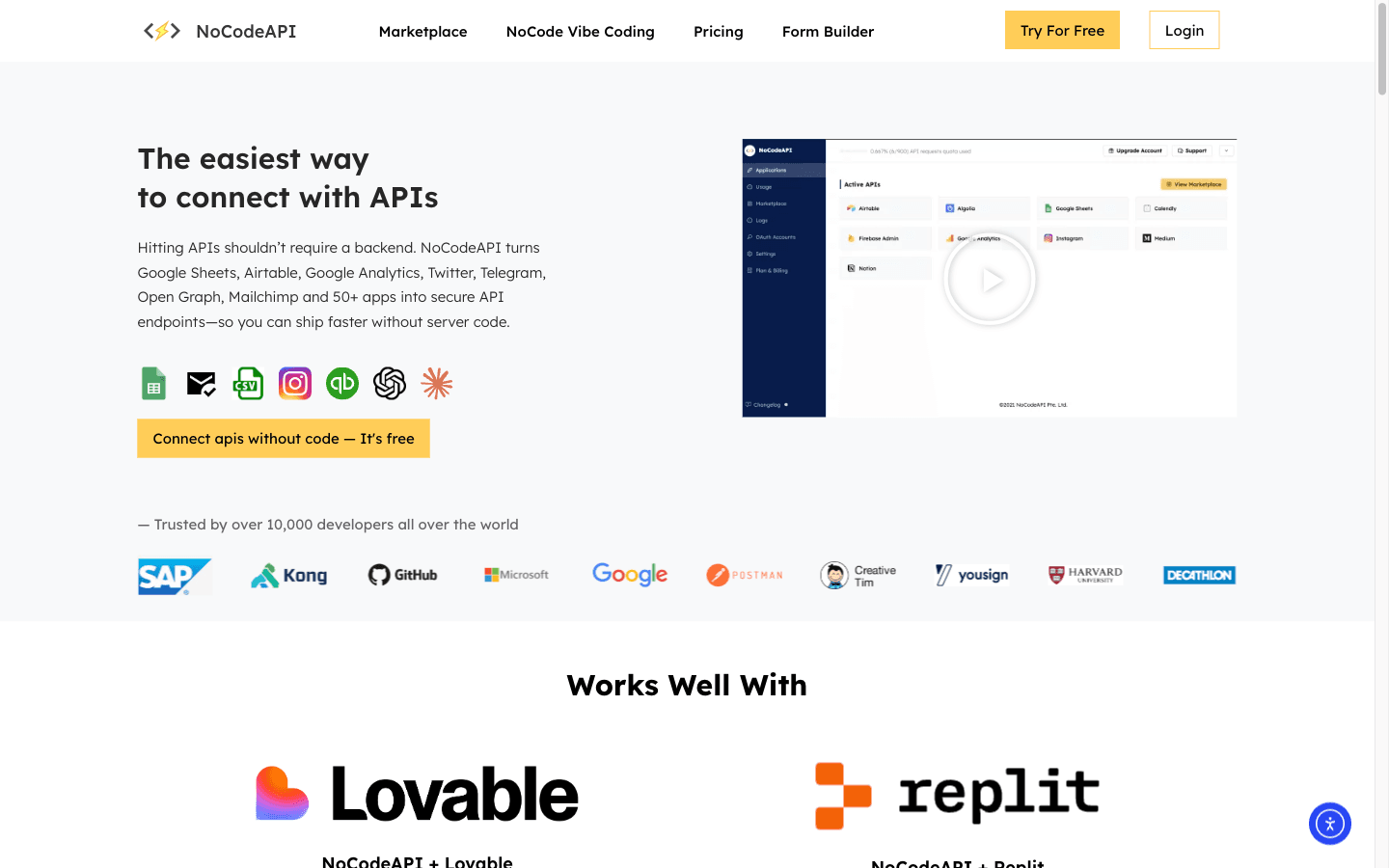
NoCodeAPI sits in the layer nobody screenshots but every automation depends on: it holds the OAuth tokens, exposes a clean REST endpoint, and keeps your keys out of the client. Free gives 300 requests/month — and pauses your endpoints after a week of inactivity, which is a real gotcha for low-volume side projects. Personal is $12/mo for 50,000 requests; Professional is $29/mo for 150,000 with multiple OAuth apps and projects; Business is $49/mo for 400,000, unlimited endpoints, and team invites. The catch: Trustpilot shows 3.1 from exactly two reviews (one saying "Good when it works. Zero support when it doesn't."), G2 has zero reviews — so treat support as a hypothesis to test with a cheap plan, not a promise. For the price of two coffees you can find out in an afternoon.
The AI spreadsheet that becomes an app
Teable is the Airtable-shaped escape hatch — a real database grid with AI that reads files and runs automations, at $13/seat/mo yearly for the Pro tier. The catch isn't features, it's proof: the independent review record is essentially one G2 review, so this is a bet on product direction, not on reviews.
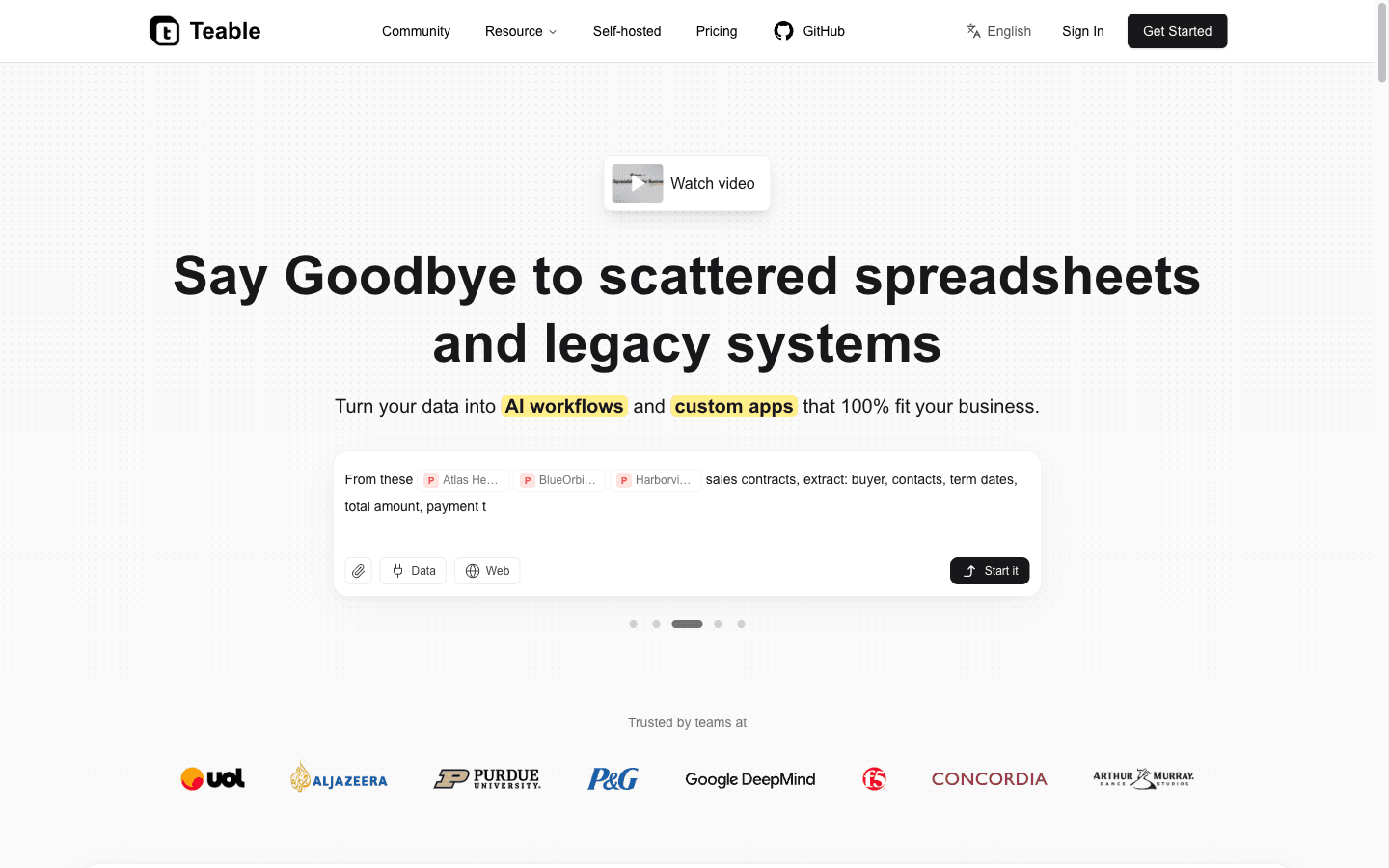
Teable markets itself as "the AI spreadsheet for business": grid view your team already understands, attached files the AI can read and summarize, automations, and a growth path into full custom apps without a migration. Free plan covers 1,000 records per base with 200 one-time AI credits; Pro is $13/seat/mo billed yearly ($24 monthly) for 250,000 records and 25,000 automation runs; Business is $20/seat/mo ($36 monthly) for a million records. Referred customers get 10% off a first payment through the partner program, which tells you the growth strategy. The catch: Trustpilot has no profile for the domain (the site redirected teable.io to teable.ai mid-verification — even the domain is migrating), and G2 holds exactly one review, five stars, dated October 2026. Every "Trusted by teams at" logo on the site is vendor-curated. Pilot it with data you can afford to re-key.
SERP data: the automation input SEO tools resell
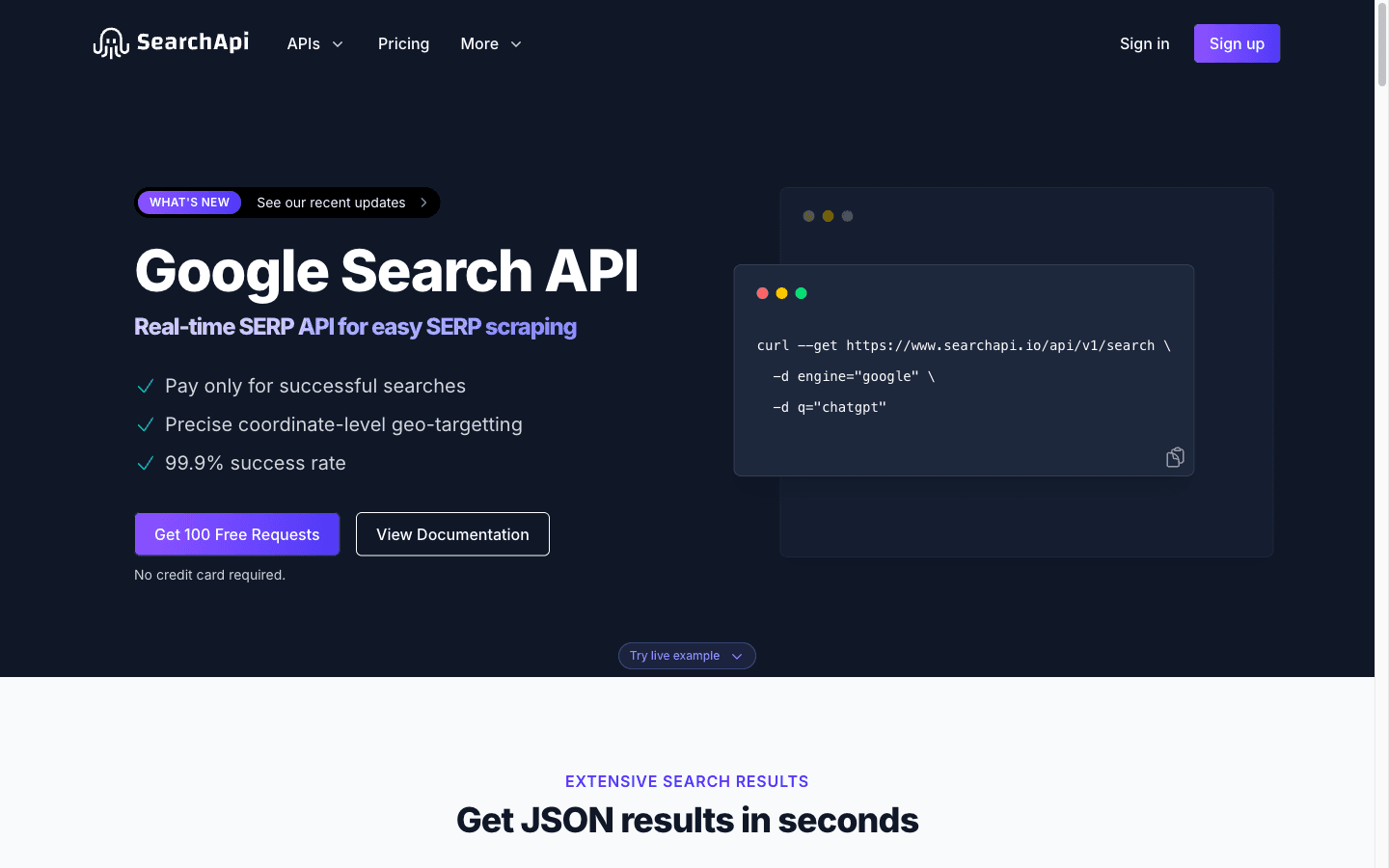
SearchApi is the plumber's tool behind half the "AI SEO" dashboards you already pay for — real-time SERP results from 70+ engines via API, from $40/mo for 10,000 searches, billed only for successful requests. If you build ranking trackers or feed LLMs search results, this is your layer; if you don't, skip it.
SearchApi sells what it says: Google, Google Maps, YouTube, Amazon, and Perplexity results (70+ engines) as structured JSON, with a Legal Protection Guarantee on the Production tier and up. Developer is $40/mo for 10,000 searches ($4 per 1,000); Production is $100/mo for 35,000 ($3 per 1,000) plus the legal guarantee; BigData and Scale drop the rate to $2.50 and $2 per 1,000. G2 sits at 4.6 from 213 reviews with docs and support as the top praise. The catch is shape, not substance: the advertised rates apply to the Google SERP engine specifically, and other engines carry their own prices — the pricing page's fine print is the real catalog. If your stack already includes a SERP API through another tool, you don't need a second one; if you're assembling an SEO automation yourself (nightly rank checks, AI answer monitoring), this is the cheapest credible entry point on this list. Related: our Best AI SEO Tools roundup covers the finished products built on this layer.
Process documentation: the automation that writes itself
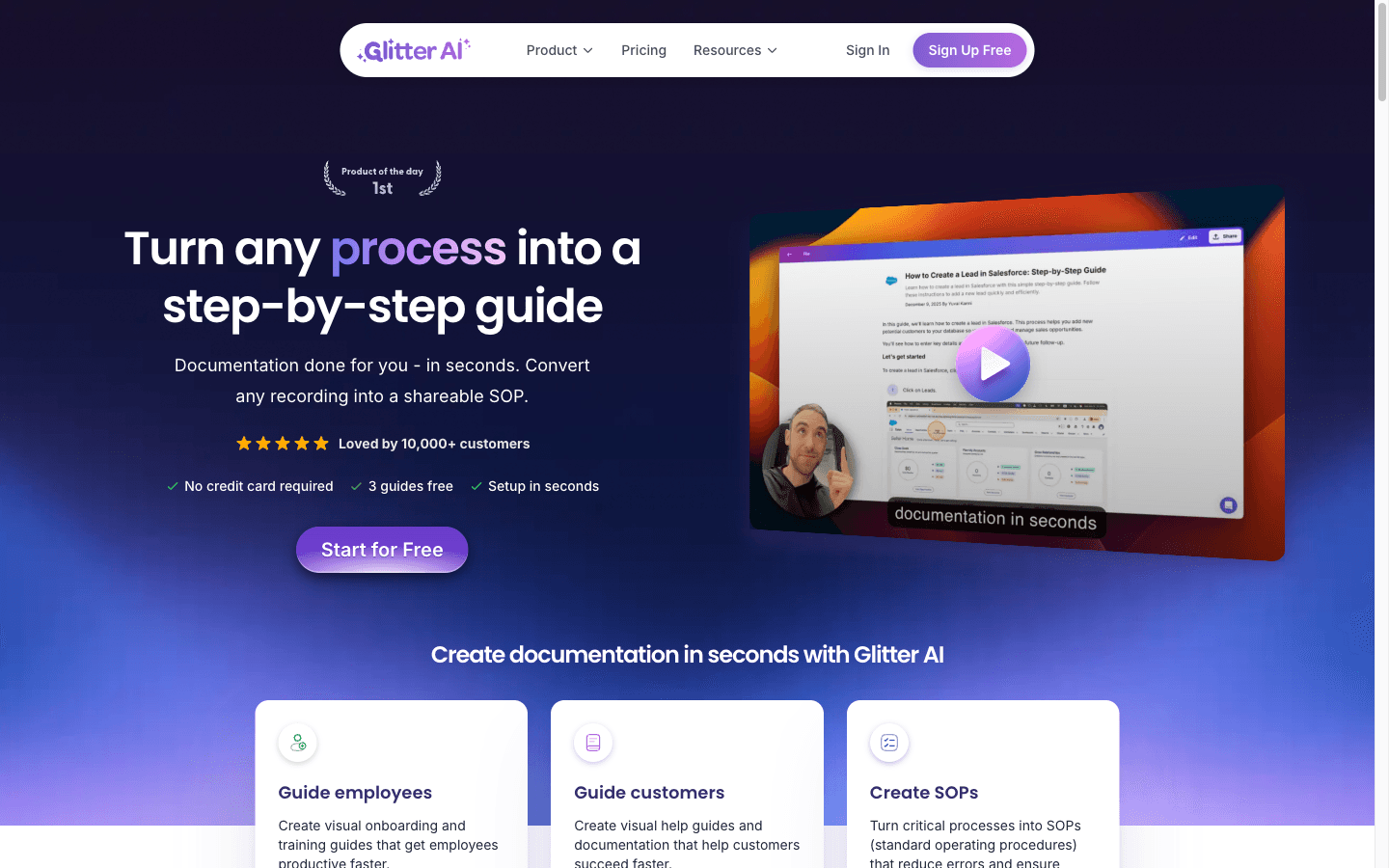
Glitter AI turns a screen recording into a step-by-step written SOP with screenshots, in 99 languages, and readers are free — the workflow-automation play for teams drowning in "how do I do X?" Slack questions. The catch is the price ladder: $249/mo is the cheapest paid tier, and the free plan is three watermarked guides.
Glitter AI records your process once, then generates the guide: numbered steps, cropped screenshots, optional AI voiceover and avatars on higher tiers, export to PDF/Word/Markdown, and an MCP server so AI assistants can pull answers from your SOP library. Free gives 3 guides total with a watermark; Growth is $249/mo for 3 creator seats (extra creators $29/mo each) with unlimited guides and readers; Scale is $499/mo with AI voiceover, avatars, version control, and SCORM export; Enterprise starts at $999/mo, yearly only, with SSO and HIPAA BAA. The catch, in one sentence: at $249/month this costs more than the payroll hours it saves until your team asks "how do I…" more than roughly a hundred times a month — do that math before the demo convinces you. Proof is also thin: G2 4.8 from exactly two reviews, no Trustpilot profile, and the "10,000+ customers" claim doesn't reconcile with anything independent we could find.
The metawork layer: automating the typing
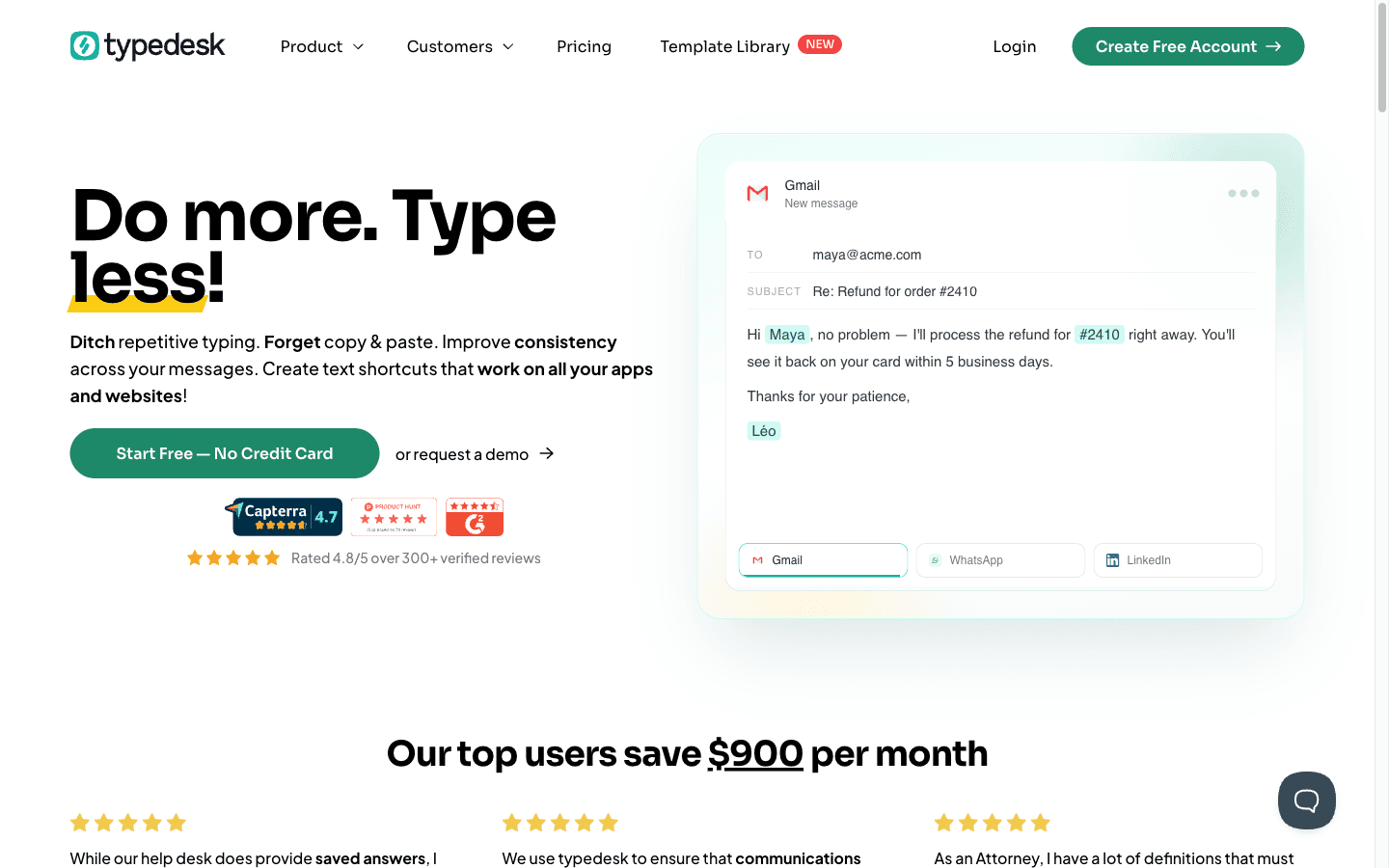
Typedesk is the least glamorous tool here and the easiest ROI — a shared canned-response library with an AI quick-reply layer, at $60/user/yr for unlimited inserts. Support teams feel this one within a week.
Typedesk puts your team's repeated text behind a "/" command anywhere: unlimited templates, shared team libraries, variables, and AI-generated reply drafts on the +AI tier. Free forever covers unlimited templates capped at 50 uses per week for one user; Premium is $60/user/yr (the yearly-equivalent works out to about $8/user/month; the monthly price derives from the "Save $36" strikethrough — the site showed yearly state when we verified); Premium+AI is $168/user/yr with AI Quick Reply, custom AI templates, and all models. G2 shows 4.7 from 24 reviews; Trustpilot is one review — thin either way, but the product is simple enough that a free week tells you everything. The catch: mobile apps are listed as "coming soon" on the plan we verified, and the AI tier is where the per-user price triples — worth it only if your team actually drafts replies, not just pastes them.
Content distribution: the automations that post while you sleep
Nuelink ($16/mo yearly) is the feed-driven workhorse with the healthiest review record in this group, Postpone ($16/mo yearly) is the only one that takes Reddit seriously, and Ocoya ($29/mo) is the AI writer-scheduler with a billing record you must read before subscribing. All three overlap with our Best AI Social Media Tools roundup — this section covers the automation angle only.
Nuelink connects RSS feeds, Etsy/Shopify stores, and podcast feeds to a posting queue across 12 platforms, with AI filling gaps in the calendar. Standard is $16/mo billed yearly ($192/yr, anniversary promo state when verified); Premium is $32/mo for 30 channels and 3,000 scheduled posts; Business is $52/mo; Agency tiers run $85.30 and $152. The review record is the healthiest in this category: Trustpilot 4.5 from 77 reviews with the company replying to every review, G2 4.8 from 47. The catch: the homepage claims "4.9/5 from 600+ verified reviews," which matches no independent platform we checked — use the audited numbers, and note the yearly promo pricing was the only state the pricing page would render.
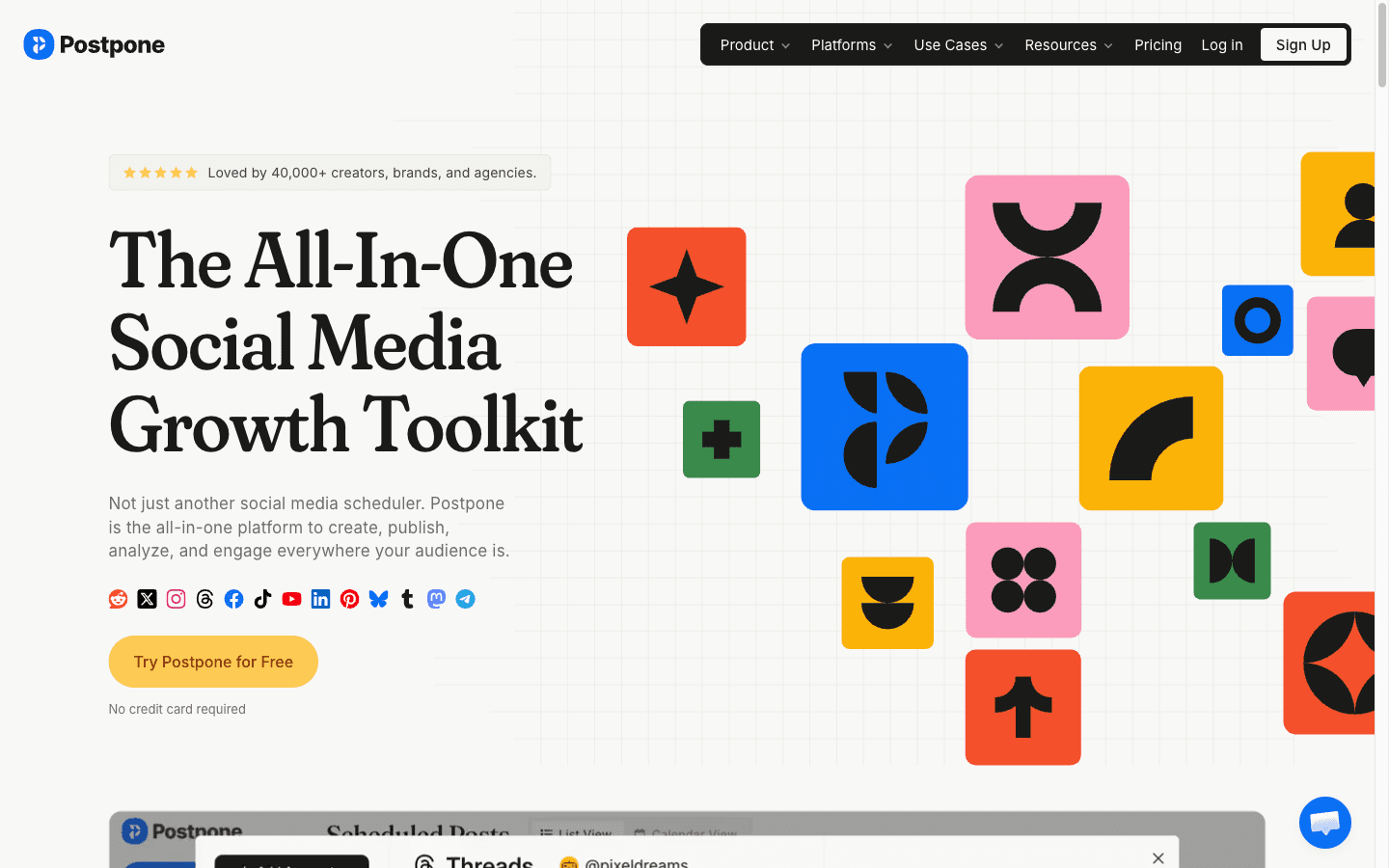
Postpone is the scheduler for people whose audience lives on Reddit (and nine other networks): subreddit discovery, post-timing analytics per community, AI post titles, and one calendar across 13 networks. Starter is $16/mo billed yearly ($24 monthly) for 3 accounts; Creator is $32/$48 for 7 accounts and unlimited scheduled posts; Professional is $64/$96; Agency is $128/mo for 30 accounts. The catch is proof again: G2 zero reviews, Trustpilot two reviews, both one-star — for a tool at this price point that's probably sampling noise rather than signal, but it means you're going on the 14-day trial, not on reviews. The "40,000+ creators" claim is unaudited.
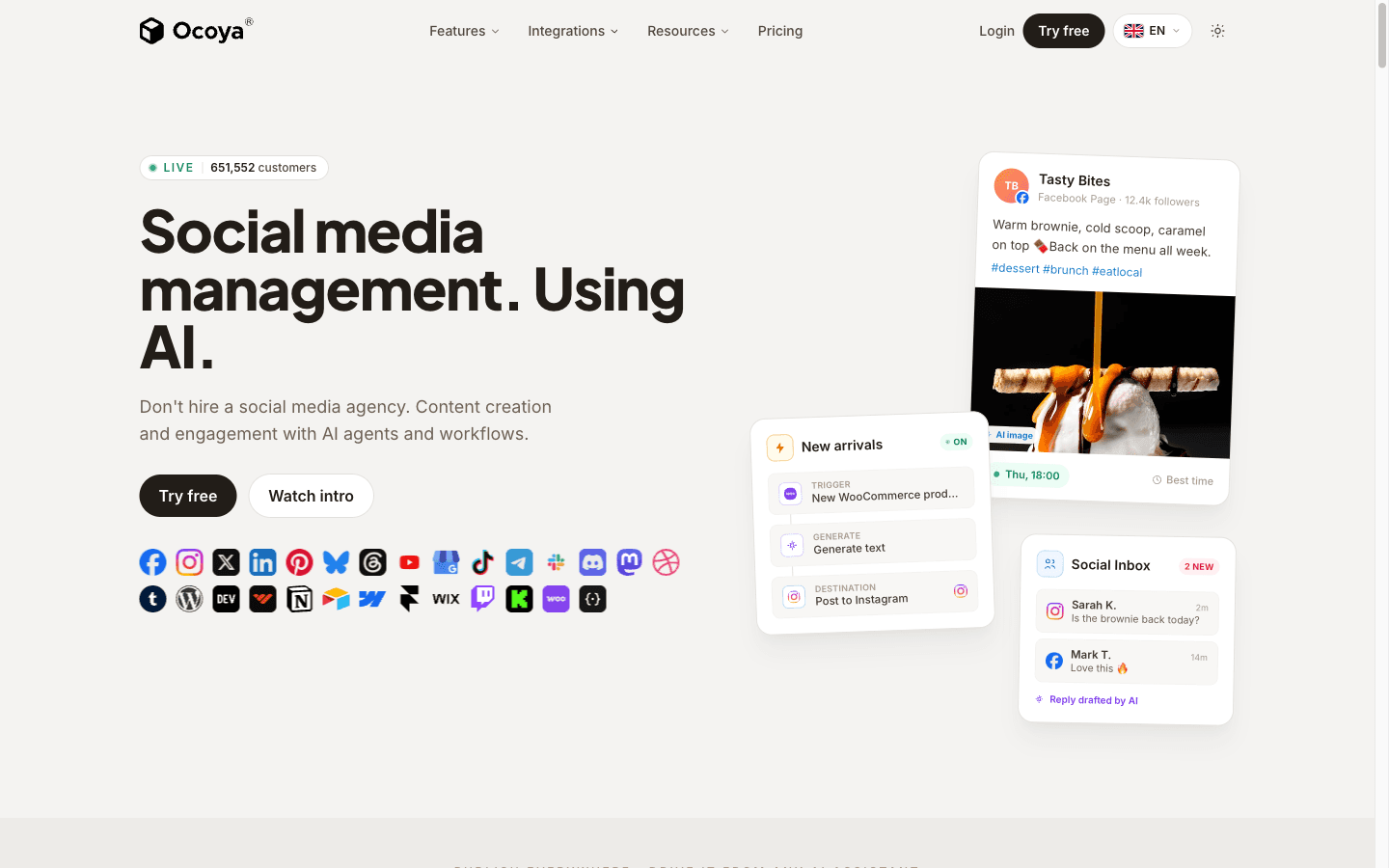
Ocoya is the AI content machine of the trio: it writes posts, generates visuals, and schedules across networks, with an MCP server so your AI assistant can drive it. Starter is $29/mo ($290/yr) for 5 scheduled posts per social profile; Team is $79/mo ($790/yr) for 20; Agency is $199/mo ($1,990/yr). And here the catch is not a footnote — Trustpilot sits at 1.3 from 227 reviews, with recent reviews dominated by billing complaints, a G2 review describing a "broken cancellation system," and a report escalated to Action Fraud UK. The 4.6 on G2 is real but old (171 reviews, mostly 2022-era). We also recommend tools with no affiliate program when they're the best fit; Ocoya is the opposite case — an affiliate program we'd point you past until the billing record changes. Trial it with a virtual card if at all.
What a working automation stack actually costs
one tool per job beats one tool pretending to do all jobs — a realistic 2026 stack runs $47–$110/month depending on whether data extraction is in scope. Verified October 2026, yearly billing where shown:
| Job | Stack | Steady state |
|---|---|---|
| Prove the concept, $0 | Apify Free + Jet Admin Free + NoCodeAPI Free | $0/mo |
| Solo operator, light data | Apify Starter + NoCodeAPI Personal | $31/mo + usage |
| Small team with internal tools | Jet Admin Pro + Teable Pro (3 seats) | $55/mo |
| SEO/data builder | SearchApi Developer + Apify Starter | $59/mo |
| Content distribution machine | Nuelink Premium + Postpone Creator | $64/mo |
| Documentation-heavy ops team | Glitter AI Growth + Typedesk Premium (3 users) | $267/mo |
Two lines deserve a second read. The Glitter row crosses the $250/month line where automation tooling starts competing with a part-time hire — that's fine for a 30-person support org, silly for a five-person team. And every "plus usage" line is the honest part of the invoice: Apify's proxy and CU costs, SearchApi's per-1,000 rate above quota, NoCodeAPI's overage — the sticker covers the floor, the meter covers the rest.
Where AI automation still breaks in 2026
the failure modes are not model quality — they're meters, support, and the gap between demo and operations. Three things to plan around before any card leaves your wallet.
- The meter is the product. Apify bills compute units and proxies separately; SearchApi's rate changes per engine; NoCodeAPI pauses free endpoints after a week; Jet Admin's AI credits refill by plan. Whatever the demo shows, price your real monthly volume at the meter rate before subscribing — including the 2–3× fudge factor for do-overs.
- Thin review bases are the norm, not the exception. Half this category has double-digit or sub-10 review counts: Jet Admin (G2 n=6, TP 0), Teable (G2 n=1), Glitter AI (G2 n=2), Postpone (TP n=2). That doesn't make them bad — it makes them unproven. Prefer monthly billing and an exit path until a tool has survived one of your real incidents.
- Billing hygiene varies wildly in the same category. Same shelf, same week: Nuelink replies to every Trustpilot review; Ocoya's recent reviews allege charges that survive cancellation. The lesson generalizes: before subscribing to any automation tool, read the most recent 12 months of reviews specifically — legacy scores from 2022 describe a different company.
Decision framework
| Your job | Pick | Verified entry price | The catch that decides |
|---|---|---|---|
| Web data at volume | Apify | $19/mo + usage | CU + proxy meters; budget 2–3 test runs |
| Internal admin panel | Jet Admin | $16/mo yearly | Review record near zero; stage it first |
| SaaS apps → API | NoCodeAPI | $12/mo | Support unproven; free tier pauses after 1 idle week |
| Spreadsheet → app | Teable | $13/seat/mo yearly | n=1 on G2; pilot with re-keyable data |
| SERP data by API | SearchApi | $40/mo | Rate card differs per engine |
| SOPs from screen recordings | Glitter AI | $249/mo | Cheapest tier crosses hire-vs-tool math |
| Repeated typing | Typedesk | $60/user/yr | AI tier triples the per-user price |
| Feed-driven posting | Nuelink | $16/mo yearly | Homepage review claim doesn't reconcile |
| Reddit-first distribution | Postpone | $16/mo yearly | Effectively no independent reviews |
| AI writes + schedules | Ocoya | $29/mo | Trustpilot 1.3 — billing complaints; use virtual card |
FAQ
What are the best AI workflow automation tools in 2026?
Sorted by job: Apify ($19/mo plus usage) for web data, Jet Admin ($16/mo yearly) for internal tools, NoCodeAPI ($12/mo) for API endpoints, Teable ($13/seat/mo) for spreadsheet databases, SearchApi ($40/mo) for SERP data, Nuelink ($16/mo yearly) for feed-driven posting. There is no single winner because "automation" covers at least six different meters and buyers who pick by logo rather than by job overpay for capacity they never use.
How much do AI automation tools cost per month?
Entry pricing ranges from $0 to $249/month for the tools we verified in October 2026: Apify $19, NoCodeAPI $12, Jet Admin $16, Teable $13/seat, Nuelink $16, Postpone $16, Ocoya $29, SearchApi $40, Typedesk $60/user/year, Glitter AI $249. Usage-based meters (compute units, API calls, proxies) sit on top of every one of those stickers and usually decide the real invoice at volume.
Are there genuinely free AI automation tools?
Yes, and they're more real here than in most AI categories: Apify's free tier includes $5/month of prepaid platform usage with no card, Jet Admin's free plan allows unlimited apps with limited AI credits, NoCodeAPI gives 300 requests/month, and Teable's free plan covers 1,000 records. The catches are ceilings, not tricks — request caps, pause-after-inactivity rules, and watermarked outputs.
What's the difference between AI automation tools and AI agents?
Automation tools follow predefined workflows on a schedule you control; agents decide their own steps at run time. In practice the line is blurry — Nuelink's queue is automation, Apify's Actors driven through an MCP server by Claude lean agentic, and our Best AI Agent Builders roundup covers the platforms where you define the agent's loop rather than the workflow. If you can write the if-then rules today, buy automation; if the input is unpredictable, look at agents.
Which AI automation tool has the best reviews?
Apify carries the strongest audited record in this set: Trustpilot 4.8 from 823 reviews (90% five-star) and G2 4.7 from 685, as of October 2026. Nuelink is second (TP 4.5/77, G2 4.8/47). Be suspicious of on-site review widgets anywhere in this category — several tools' homepage claims (Ocoya's legacy 4.6, Nuelink's "600+ verified," Glitter AI's 4.8) don't reconcile with the current independent record.
Do I need an automation tool if I already use Zapier or Make?
Often yes — the tools here do jobs Zapier and Make don't: Apify extracts data from sites that have no API, SearchApi sells SERP results, Teable is the database those platforms connect to, and Jet Admin builds the interface your team works in. The realistic 2026 pattern is Zapier or Make as the router between specialists, not as a replacement for them. Start with the specialist for your bottleneck job and keep the router you have.
Related Guides
- Best AI Agent Builders (2026) — when the job needs decisions, not just schedules
- Best AI Social Media Tools (2026) — the full management-layer comparison behind the distribution section
- Best AI SEO Tools (2026) — the finished products built on top of SERP data layers
- AI Tool Comparisons Hub — every head-to-head on the site
- Browse all AI automation tools in the directory
Last updated: October 27, 2026. Pricing verified October 26–27, 2026 from vendor pricing pages, both billing toggles where shown; ratings reflect documented strengths and failure modes from our full tool pages, not hands-on deployments.
Disclosure: This article contains affiliate links. All ten tools above have active affiliate programs, with commissions verified from signup pages October 2026: Apify 20–30% recurring (up to $5,000 per referral), Glitter AI 30% (first 12 months), Jet Admin 30% recurring, NoCodeAPI 30% (first 12 months), Nuelink 30% on all plans, Ocoya 30% (first 12 months), Postpone 20% (first 12 months), SearchApi 30% (first 12 months), Teable 25% recurring (first 12 months), Typedesk 30% recurring (up to 12 months). We also recommend tools with no affiliate program when they're the best fit — and flag tools with programs when their record argues against subscribing. Pricing can change — verify at checkout.