Best AI Customer Service Tools 2026: 7 Tools Compared by Support Job
Last Updated: October 27, 2026 Method: Research-only. Every price below was verified against vendor pricing pages on October 26–27, 2026, including both billing toggles wherever shown. We have not deflected real customer tickets with these tools; judgments come from the documented record — vendor specs, pricing mechanics, Trustpilot, G2 — not from our own resolution rates. Commission figures in the disclosure come from affiliate signup pages pulled the same week.
Support tooling in 2026 splits into two different purchases that share one category page: the AI agent that answers questions from your docs (metered in messages and credits), and the shared inbox where humans + AI handle conversations (metered in seats and channels). Buying the wrong one is expensive in both directions — an AI chatbot can't triage a WhatsApp escalation, and a seat-based inbox burns money answering "what are your hours?" The search data shows the intent split: "ai customer service tools" (480/mo) is the head, but "best ai customer service tools 2026" sits at just 110 searches with a KD of 22 — one of the most rankable commercial terms we validated this quarter. One question dominates the cluster, and it's the right one: which tools have transparent pricing? That question gets its own section, because in this category the credit math is the product.
All seven tools below have full review pages on BestAIStack with pricing verified October 2026.
Quick answer: for a docs-trained AI support agent, Chatwith ($9/mo to start) has the most transparent credit math and can take real actions in your stack; Wonderchat (free–$32.50/mo yearly) is the closest alternative with a free plan and a 4.9 G2 — we ran the comparison: Chatwith vs Wonderchat. For document-trained bots with voice, FastBots ($33/mo annual) publishes its model-cost math in full. For the inbox itself, Chatwoot (free self-host; $19/agent cloud) is the open-source pick with 38K GitHub stars. For WhatsApp-first sales-support desks, Rasayel ($30/user, 5-seat floor) and Periskope ($25/user) take opposite approaches to the same channel. WotNot ($29/mo) is the no-code flow builder with an AI studio attached.
One line worth keeping: in AI support, "transparent pricing" means the vendor publishes what an AI reply costs — half this category does, half hides it, and the difference is your monthly invoice.
Docs-trained AI agents: the credit-math buyers' guide
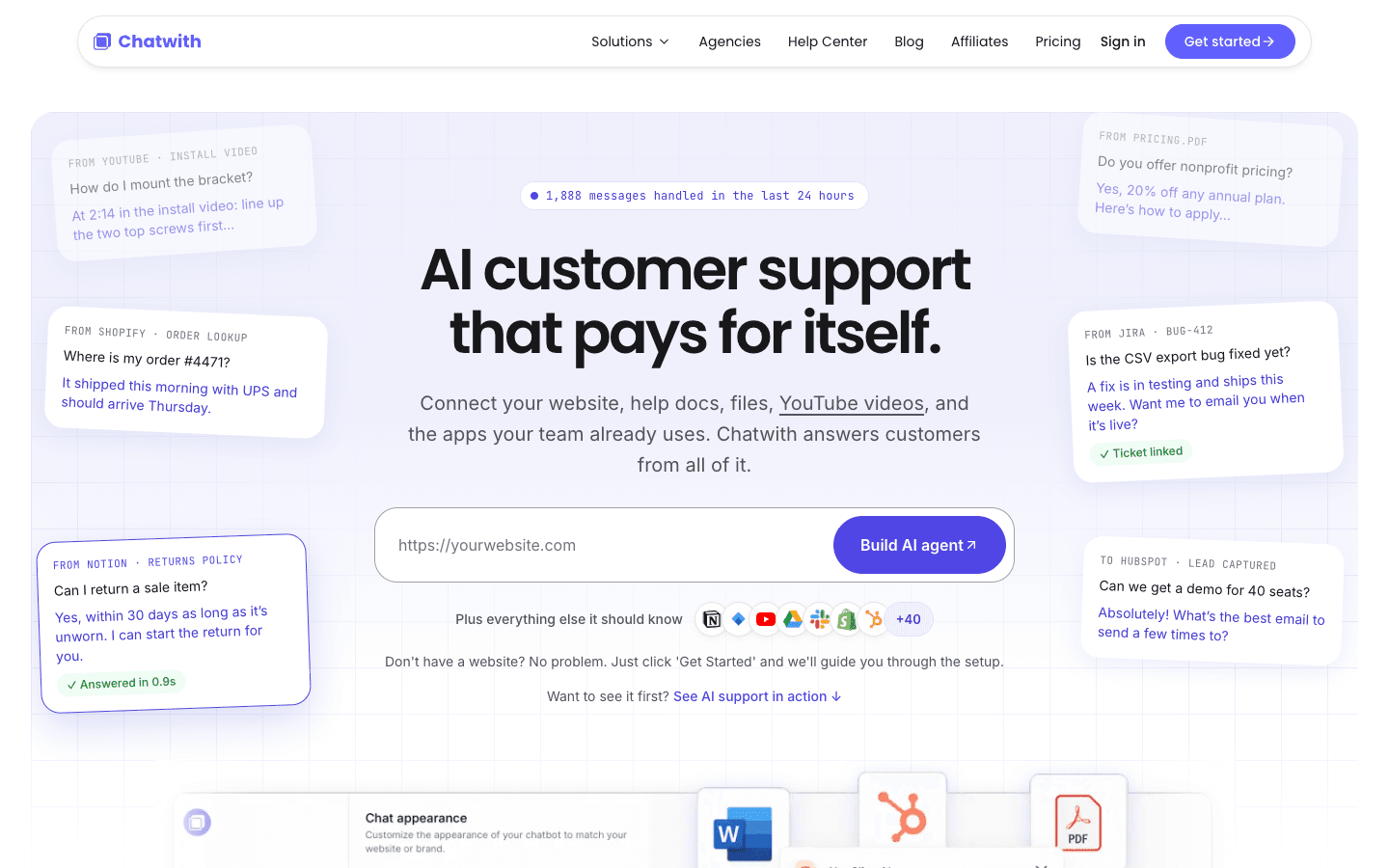
Chatwith is the transparent-pricing pick — published credit-to-conversation math, actions in 6,000+ apps, from $9/mo — while Wonderchat counters with a free plan, frontier models on higher tiers, and the best review score here (G2 4.9). This is the most direct matchup in the roundup, and we broke it down separately: Chatwith vs Wonderchat.
Chatwith trains an AI agent on your docs, files, and site, then lets it act — check orders, create tickets, hit your API. Starter is $9/mo ($90/yr) for 250 credits (~50 conversations); Hobby is $19/mo ($190/yr) for 1,000 credits; Standard is $99/mo ($990/yr) for 10,000 credits and 3 agent seats; Business is $399/mo ($3,990/yr) for 40,000. There's no free plan — the 7-day trial on paid tiers is the test drive. The transparency is real: the pricing table publishes the ~conversations-per-credit math and states plainly that frontier AI models burn credits faster than fast ones — a cost spread the vendor puts at up to 50× between model classes. The catch is the same fact from the buyer's side: your invoice depends on which model you assign, and the independent review record is near zero (a single G2 review, from an agency partner of the founder, no Trustpilot profile) — so the 7-day trial on your real docs is the only evaluation that counts. Commission note: the affiliate program pays 33% of every payment, one of the highest rates we've verified this quarter — which is also why you'll see this tool recommended in a lot of listicles, including principles of disclosure that we follow here.
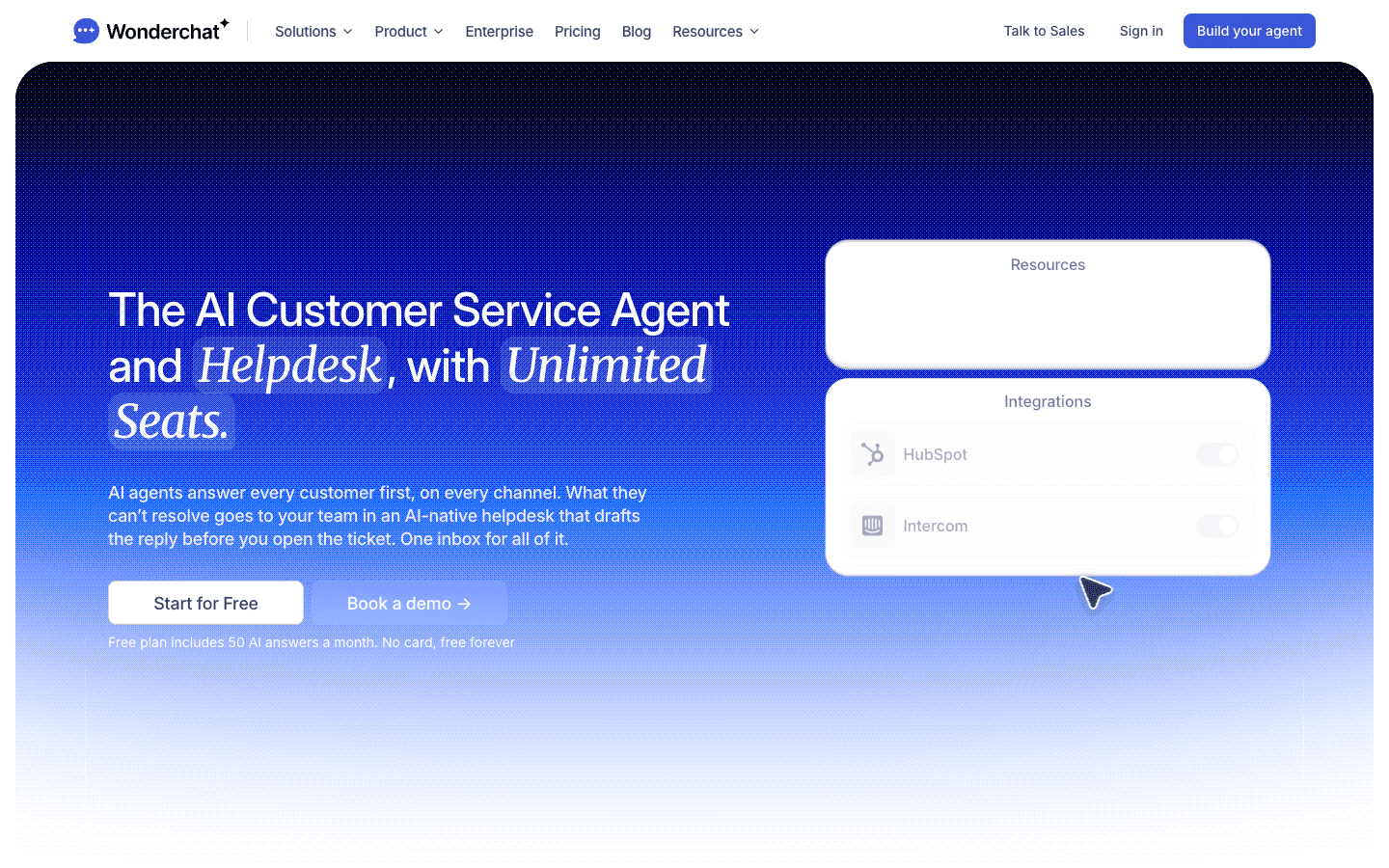
Wonderchat trains a chatbot on your docs with citation-backed answers that flag what it doesn't know — and misfires get converted into draft help articles, a feedback loop reviewers praise. Free covers 50 messages across 20 pages; Starter is $32.50/mo billed yearly ($39 monthly) for 500 messages; Basic is $125/mo ($149 monthly) for 3,000 with frontier models; Scale is $417/mo ($499 monthly) for 10,000. Seats are free on every plan — the meter is AI replies only. G2 shows 4.9 from 23 reviews (the best score in this roundup), with fast setup and human support replies in minutes as the pattern. The catches: run out of AI replies and the bot goes silent mid-month — a support outage caused by your own billing tier — and there's no Trustpilot profile, so the 23-review G2 base is the whole record. The site's own rating widgets say 4.5 and 4.8; live G2 says 4.9; we use the live number.
Document-trained bots with the math on the table
FastBots at $33/mo annual is the pick when your bot needs to train on long documents and you want the model-cost arithmetic published in full — including the warning that frontier models burn credits 10× faster than defaults. The catch: the review record is two G2 reviews, one of them incentivized, and the G2 overview was written by the founder.
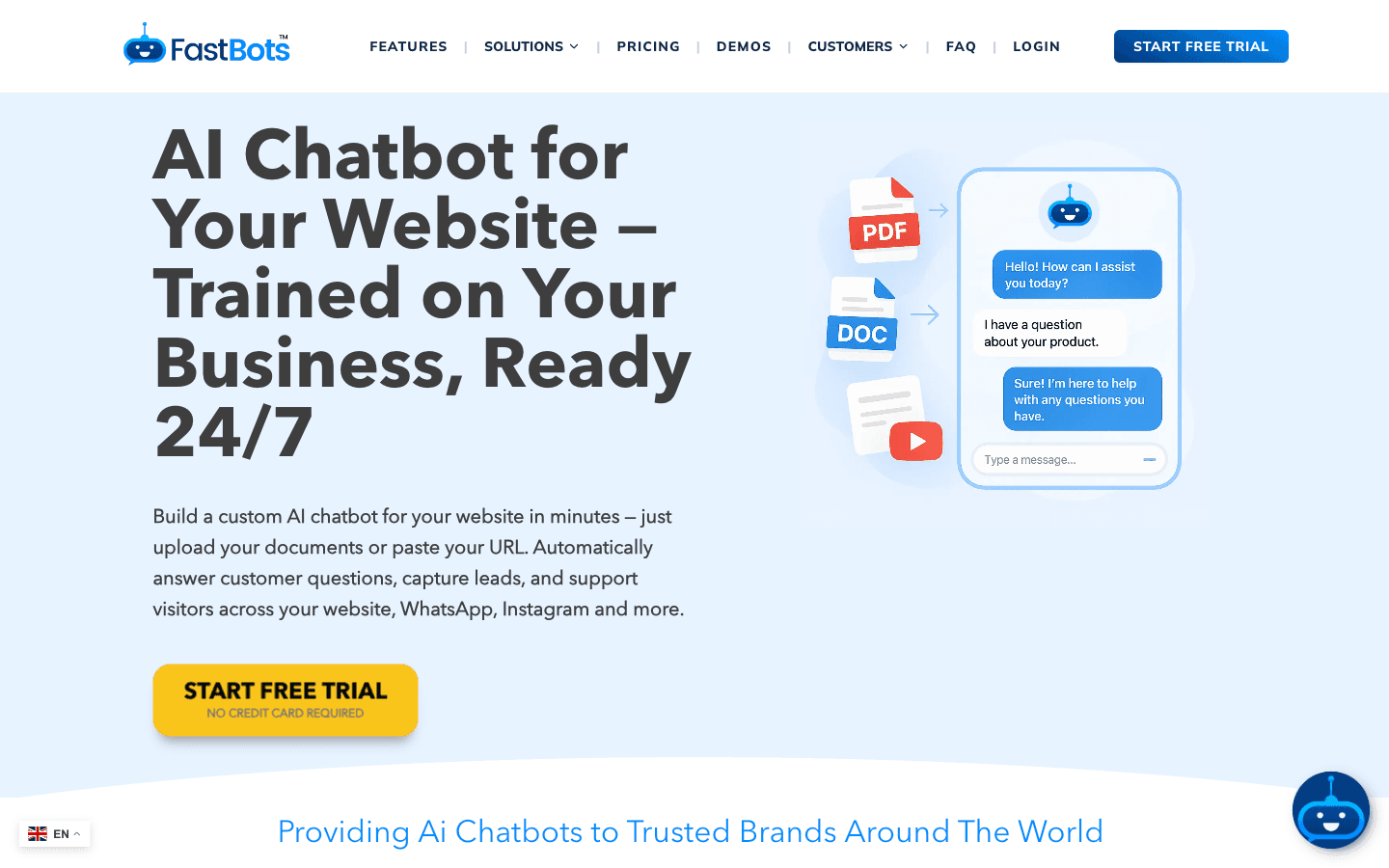
FastBots builds chatbots trained on documents, files, and crawled pages, with voice chatbots from the Business tier. Essential is $33/mo — $396 billed annually, a "save $72" frame worth reading carefully — for 2 bots and 2,000 message credits; Business is $75/mo ($900/yr) for 5 bots, 5,000 credits, voice, and translation; Premium is $165/mo ($1,980/yr) for 10 bots and branding removal; Reseller is $333/mo ($3,996/yr) for 30 bots with white-label. The transparency is genuine — the published credit math is the most complete in the category. The catches: Trustpilot and Capterra have zero reviews, G2 holds two (one an incentivized invite, and the overview authored by founder Jason West — we verified the byline), and reviewers note limited advanced customization. Treat it as a capable product with an empty trust ledger: annual billing only after a month of monthly.
The open-source inbox: free forever, if you host it
Chatwoot is the only tool here where $0 is a real production path — self-host the Community Edition free forever, or pay $19/agent on cloud. The catch: the AI (Captain) is metered separately, and voice is gated to Business.
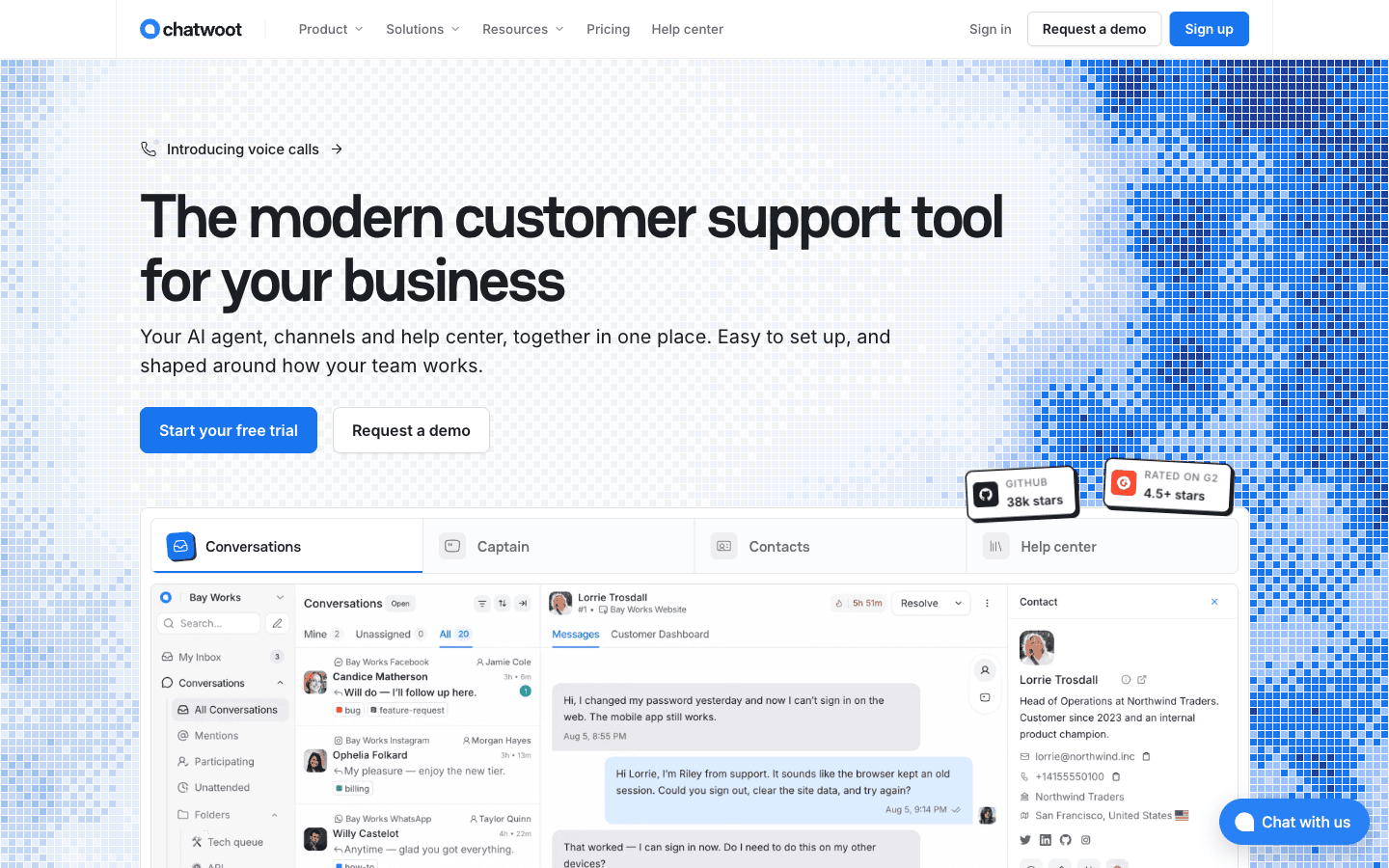
Chatwoot is the open-source support desk: live chat, email, WhatsApp (including calls), Instagram, Messenger, Telegram in one omnichannel inbox, with 38K GitHub stars and 15,000+ businesses claimed. Cloud pricing: Hacker is free (2 agents, 500 conversations/month, live chat only); Startups is $19/agent/mo with all channels and 300 Captain AI credits; Business is $39/agent/mo with 500 credits; Enterprise is $99/agent/mo with 800 credits and 3-year retention. Captain AI extras run $20 per 1,000 credits, and the Community Edition remains self-hostable with the same feature rows — a genuine exit path most SaaS can't offer. G2 sits around 4.5 with small support teams praising the flat per-agent pricing across every channel. The catches: voice is Business-tier only, AI is a separate meter on top of seats (budget both), and self-hosting means you own the uptime SLA — free forever is free until production breaks at 2am, which is exactly what the $19/agent tier buys back.
WhatsApp-first desks: two bets on the same channel
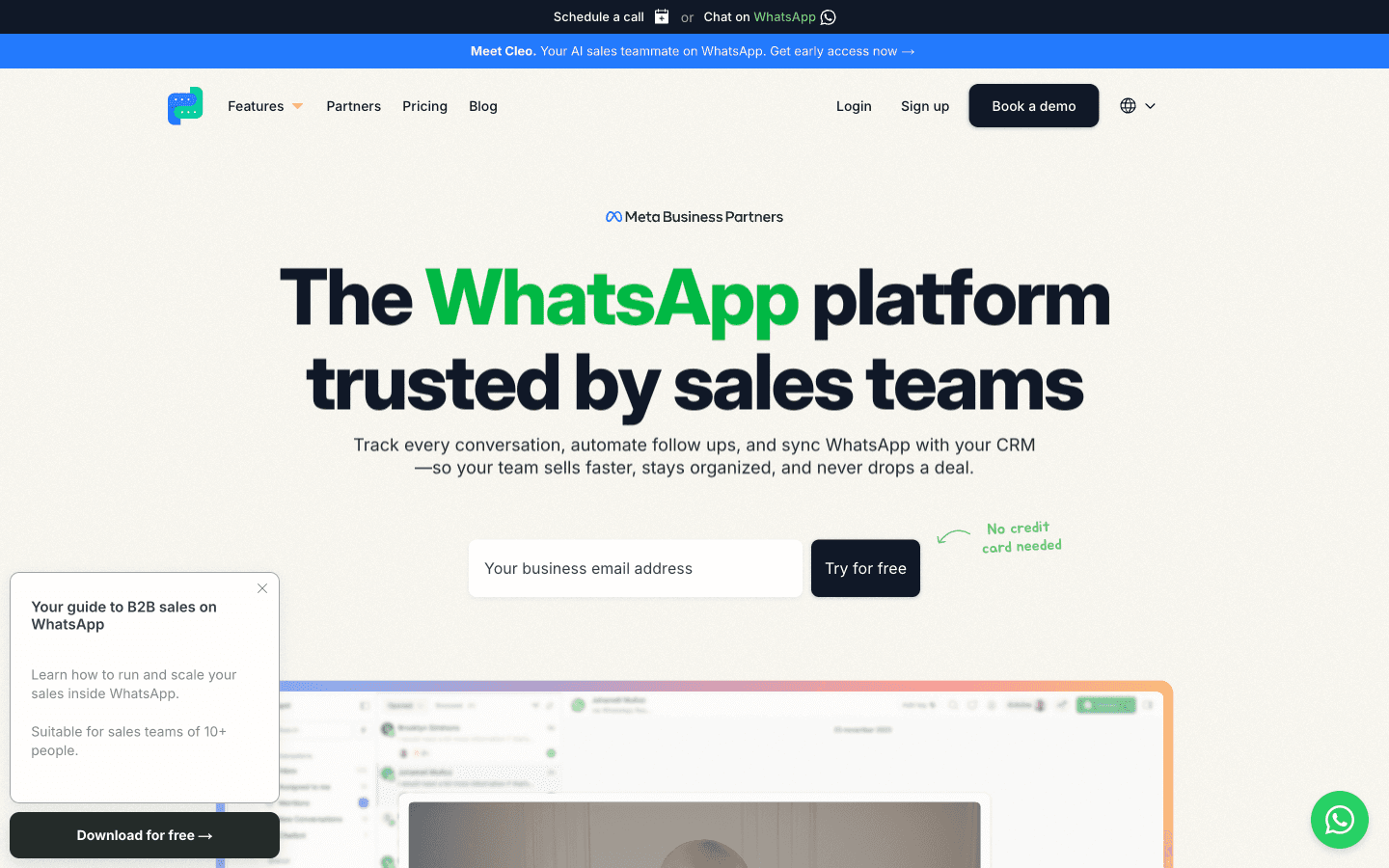
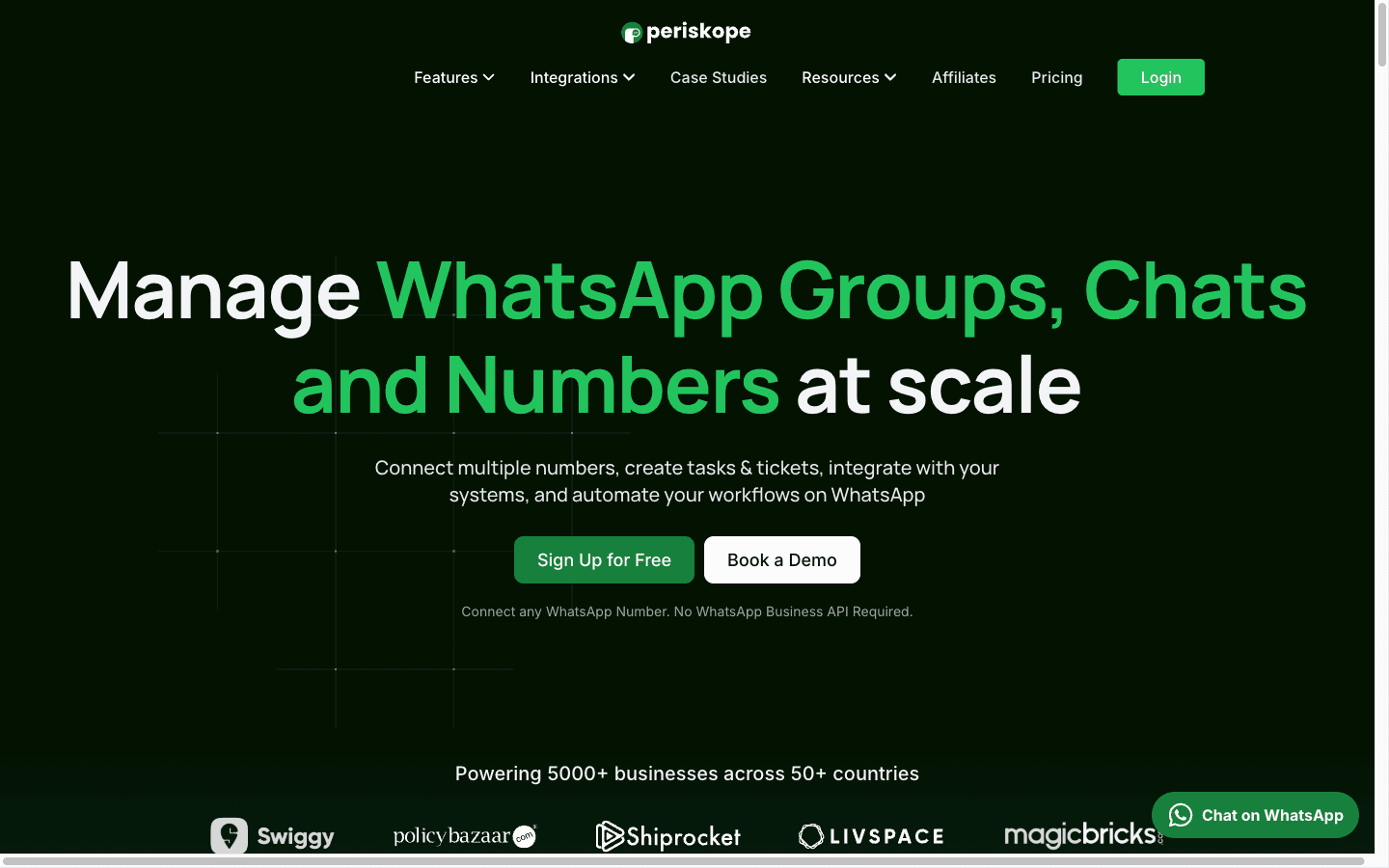
Rasayel ($30/user/mo, 5-seat minimum) is the B2B sales-support desk on WhatsApp with chatbots and sequences built in; Periskope ($25/user/mo) runs on regular WhatsApp numbers with no Business API approval queue. Same channel, opposite architectures — and both meter per seat, so team size decides everything.
Rasayel is a shared inbox for WhatsApp-led B2B sales: broadcast campaigns, a no-code chatbot builder (5 bots from the lowest tier), API and webhooks, and AI assistance. Start is $30/user/mo with a 5-member minimum ($150/mo floor); Grow is $40/user/mo with a 10-member minimum ($400/mo) adding advanced automations and reporting; Enterprise starts at $2,000/mo annual. Extras: $20/mo per additional phone number, $300/mo for Salesforce. Reviews lean positive at usable scale — Ease of Use is the top G2 tag (22 mentions), support gets named-employee praise, and one Trustpilot reviewer onboards a 27-person team "in minutes." The catches: the seat floor makes this a poor fit under 5 people no matter how good the per-seat price looks, G2 cons repeat Limited Features and Poor Navigation clusters, and a few "Soon" features on the pricing page are exactly that.
Periskope runs WhatsApp groups as a support operation on regular numbers — no WhatsApp Business API, no template approvals, no per-conversation Meta fees. Groups become tickets with owners and SLAs (the single most-praised capability in its small G2 base). Starter is $25/user/mo with the first connected phone free ($25/mo per extra phone); Pro is $35/user/mo adding a knowledge-base AI agent with 5,000 credits per license; Enterprise requires 50+ users or phones, custom. Add-ons price separately: AI Pack $25 per 10,000 credits, Rules Pack $50/mo, onboarding $200 one-off. The catches: costs stack per user AND per phone — model your org's phone count before the seat math flatters you — and the trust ledger is thin (G2 4.8 from four reviews, one of which drifts off-topic; Trustpilot zero; the homepage claims 5,000+ businesses while its own affiliate signup says 2,000+). No affiliate program exists as of October 2026 — we feature it on its architecture, not its commission.
The flow-builder hybrid
WotNot ($29/mo to start) is the no-code flow builder with an AI studio bolted on — the pick when your support is half decision-tree (lead qualification, routing) and half AI answers. The catch: double metering (chats + AI credits) and a one-sided review record.
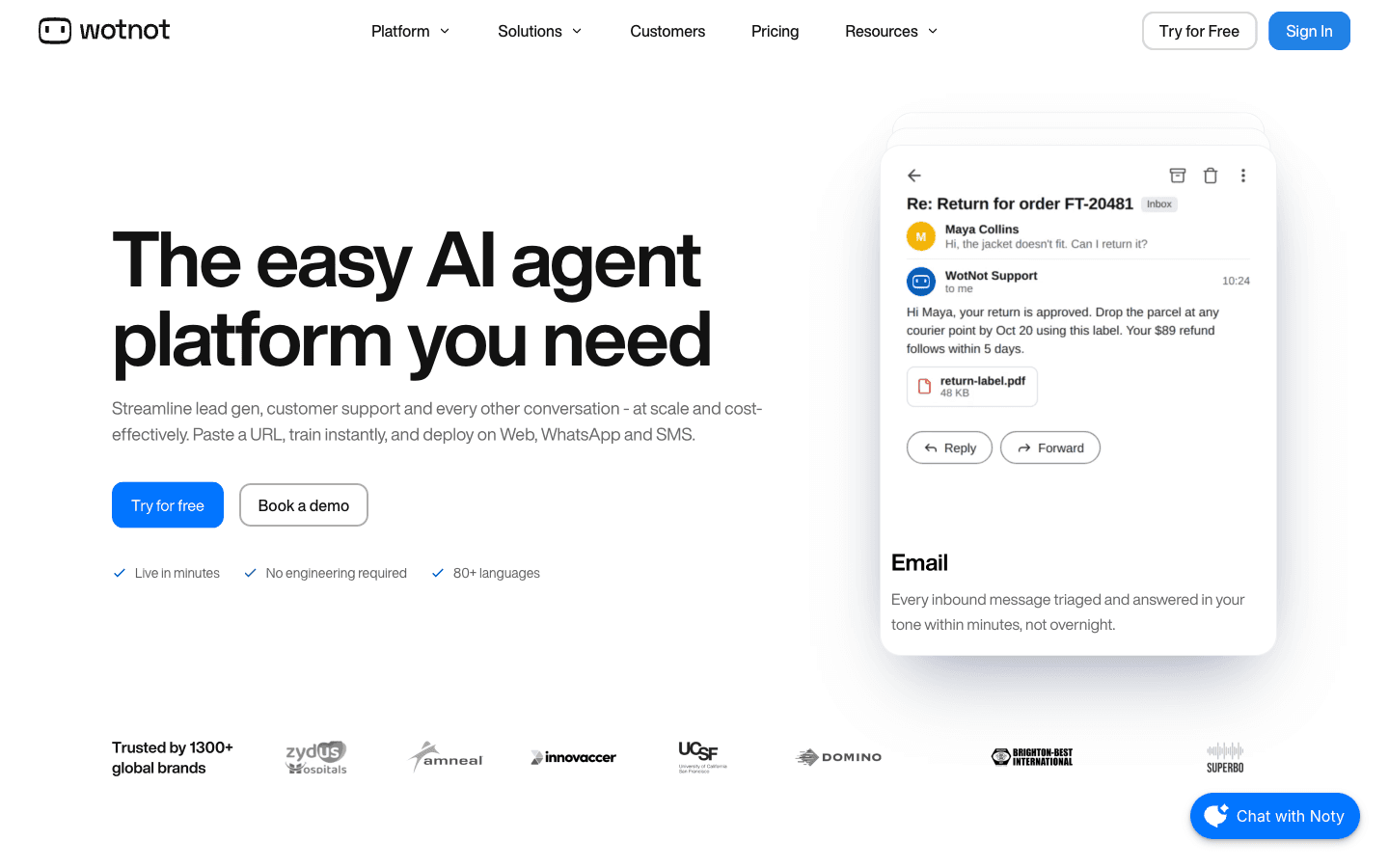
WotNot builds guided flows (Zapier-connected from Lite) and trains AI on URLs and help articles. Lite is $29/mo billed monthly for 1,000 chats + 1,000 AI credits; Starter is $99/mo for 5,000 + 5,000 with the AI Studio; Premium is $299/mo for 10,000 + 10,000 and adds live chat, HTTP requests, and branding removal. SSO and on-prem sit behind Enterprise (contact sales). G2 shows 4.6 from 102 reviews with none below four stars — a claimed profile with the overview written by a co-founder, zero Trustpilot reviews, and the site quoting itself two different customer counts ("1300+" and "3K+") on one page. The catches: the double meter means a chat-heavy, AI-light month still burns chat quota while AI credits idle, G2's AI summary flags builder lag on complex flows, and live chat only exists from $299 — the entry tiers are bot-only, which is exactly the split-buying decision this roundup started with. Decide which half you're buying.
Which AI customer service tools have transparent pricing?
Answer first, because 140 searchers a month ask exactly this: Chatwith and FastBots publish their credit math in full (conversations per credit, model-class multipliers); Chatwoot publishes per-agent and per-credit AI prices; Wonderchat publishes message quotas with free seats but no per-conversation cost; Periskope and Rasayel publish per-seat prices with published add-on rates — but your phone/seat count is the variable; WotNot publishes both meters (chats and credits) side by side. The honest grading: the two pure AI-agent tools (Chatwith, Wonderchat) are the most predictable per conversation; the desks (Rasayel, Periskope) are the most predictable per organization, once you count phones. What none of them publish is your volume — so the working method is: take your last 90 days of ticket volume, divide by the credits-per-conversation number the vendor publishes, and price all seven in a spreadsheet before any trial converts you.
What a working AI support stack actually costs
most teams need one AI agent OR one desk — running both is for high-volume operations. Verified October 2026:
| Support job | Stack | Steady state |
|---|---|---|
| Answer docs questions, tiny budget | Wonderchat Free | $0/mo |
| AI agent with real actions | Chatwith Hobby | $19/mo |
| Bot + voice for a small agency | FastBots Business | $75/mo (annual) |
| 3-person support team, all channels | Chatwoot Startups × 3 | $57/mo + AI credits |
| WhatsApp B2B sales-support, 5 people | Rasayel Start | $150/mo |
| WhatsApp group-based ops, 4 users + 3 phones | Periskope Starter | $175/mo |
| Lead-qual flows + AI answers | WotNot Starter | $99/mo |
The pattern worth naming: the WhatsApp rows are the expensive ones because seats multiply — Rasayel's 5-seat floor and Periskope's per-phone stacking both assume a team. Solo operators deflecting docs questions should start in the top three rows and stay there; the desks earn their price when tickets need ownership, SLAs, and handoffs.
Where AI customer service tools still break in 2026
the failure modes are silent-bot outages (credit exhaustion), seat-floor mismatches, and review records thinner than the stakes. Three checks before you connect a bot to real customers.
- Credit exhaustion is a support outage. Wonderchat's bot goes silent when replies run out; Chatwith's costs swing up to 50× by model class; WotNot double-meters chats and credits. Set the plan by your worst month, not your average — and alert on the credit balance the way you'd alert on the bot itself.
- The seat floor is a commitment device. Rasayel's 5-user minimum and Periskope's 50-user enterprise threshold both assume teams that don't exist yet. If your support team is 1–3 people, the per-agent inbox tools (Chatwoot) or pure AI agents (Chatwith, Wonderchat) fit; the WhatsApp desks are for orgs with shift schedules.
- Trust ledgers are thin across the board. The best-reviewed tool here (Wonderchat, G2 4.9) has 23 reviews; three others have fewer than 5 or none on Trustpilot. In this category the trial on your own docs is worth more than any scorecard — and it's why every pick above names its trial terms explicitly.
Decision framework
| Your support job | Pick | Verified entry price | The catch that decides |
|---|---|---|---|
| Docs-trained AI agent, transparent math | Chatwith | $9/mo Starter | No free plan; model class swings cost 50× |
| Citations + free plan | Wonderchat | Free (50 msgs); $32.50/mo yearly | Silent bot at credit exhaustion; 23-review record |
| Document-trained bot + voice | FastBots | $33/mo annual (Essential) | Founder-written G2 overview; empty TP/Capterra |
| Open-source omnichannel inbox | Chatwoot | Free self-host; $19/agent cloud | AI metered separately; voice at Business |
| WhatsApp B2B desk, teams of 5+ | Rasayel | $30/user (5-seat floor) | Floor pricing; "Soon" features |
| WhatsApp groups as tickets | Periskope | $25/user (+$25/phone) | Per-user + per-phone stacking; thin reviews |
| Guided flows + AI studio | WotNot | $29/mo Lite | Double meter; live chat only at $299 |
FAQ
What are the best AI customer service tools in 2026?
Sorted by job: Chatwith ($9/mo) and Wonderchat (free–$32.50/mo yearly) for docs-trained AI agents, FastBots ($33/mo annual) for document-trained bots with voice, Chatwoot (free self-host, $19/agent cloud) for the open-source omnichannel inbox, Rasayel ($30/user) and Periskope ($25/user) for WhatsApp-first desks, and WotNot ($29/mo) for guided flows with an AI studio. Pick by whether your bottleneck is answering questions (AI agents) or managing conversations (desks) — running both is a high-volume pattern, not a starting point.
Which customer service AI tools have transparent pricing?
Chatwith and FastBots publish the most complete credit math — conversations per credit and model-class cost multipliers (up to 50× and 10× respectively) are on the pricing page, not in a sales call. Chatwoot publishes per-agent and per-credit prices; Wonderchat publishes message quotas with free seats. The partials: Rasayel and Periskope are predictable per seat once you count phones, and WotNot's double meter (chats + credits) is published but requires modeling both. Our method: 90 days of ticket volume × published per-conversation costs, in a spreadsheet, before any trial.
How much do AI customer service tools cost per month?
Verified October 2026: entry points run $9–33/month for AI agents (Chatwith $9, WotNot $29, FastBots $33, Wonderchat $32.50 yearly), $19–39 per agent per month for cloud inboxes (Chatwoot), and $25–40 per user for WhatsApp desks with team minimums (Periskope, Rasayel — the $150–400/mo floors are the real entry). A solo operator deflecting docs questions spends $9–33; a five-person support team spends $150–195 before AI credits; WhatsApp desks for real teams start at $150.
Can an AI chatbot really replace first-line support?
For docs-answerable questions, verified tools now handle the majority — that's what citation-backed bots (Wonderchat) and action-taking agents (Chatwith) are built for, and the honest failure mode is the silent bot at credit exhaustion, not wrong answers. What they don't replace: escalations requiring judgment, billing disputes, and anything your docs don't cover — which is why the strongest pattern in 2026 is AI-first routing with human handoff, not AI-only. Every tool here integrates handoff differently; test it with your hardest ticket, not your easiest.
Is Chatwoot really free?
The Community Edition is free forever when you self-host — all channels, no conversation limits, your infrastructure, your uptime. The free cloud tier (Hacker) is limited: 2 agents, 500 conversations/month, live chat only. Realistic cloud pricing starts at $19/agent/month (Startups), and the AI layer (Captain) bills separately at $20 per 1,000 credits on any tier. So: genuinely free if you run the servers, $19+/agent if you don't — and the 38K GitHub stars say the self-host path is well-trodden.
What's the difference between a chatbot and a shared inbox?
A chatbot (Chatwith, Wonderchat, FastBots) answers questions autonomously from your content and meters in AI replies; a shared inbox (Chatwoot, Rasayel, Periskope) routes conversations to humans with assignment, SLAs, and history, metering in seats. WotNot sells the hybrid — flows for the deterministic parts, AI for the rest. If 80% of your tickets repeat from your docs, buy the chatbot first; if tickets need ownership and cross-team handoffs, buy the desk; and if you can't tell, the free tiers of Wonderchat and Chatwoot answer the question in a week at $0.
Related Guides
- Chatwith vs Wonderchat — the head-to-head behind the agents section
- Best AI Sales Tools (2026) — the pre-sale half of the conversation
- Best AI Agent Builders (2026) — when support automation becomes an agent platform
- AI Tool Comparisons Hub — every head-to-head on the site
- Browse all AI customer service tools in the directory
Last updated: October 27, 2026. Pricing verified October 26–27, 2026 from vendor pricing pages, both billing toggles where shown; ratings reflect documented strengths and failure modes from our full tool pages, not hands-on ticket runs.
Disclosure: This article contains affiliate links. Most tools above have active affiliate programs, with commissions verified from signup pages October 2026: Chatwith 33% of every payment, Wonderchat 20% recurring (first year), FastBots 20% recurring lifetime, Chatwoot 20% (first 12 months), Rasayel 20% recurring, WotNot 30% (first 12 months). Periskope had no affiliate program when we verified — it's featured on its architecture, not its commission. We also recommend tools with no affiliate program when they're the best fit. Pricing can change — verify at checkout.