

What is Chatwith?
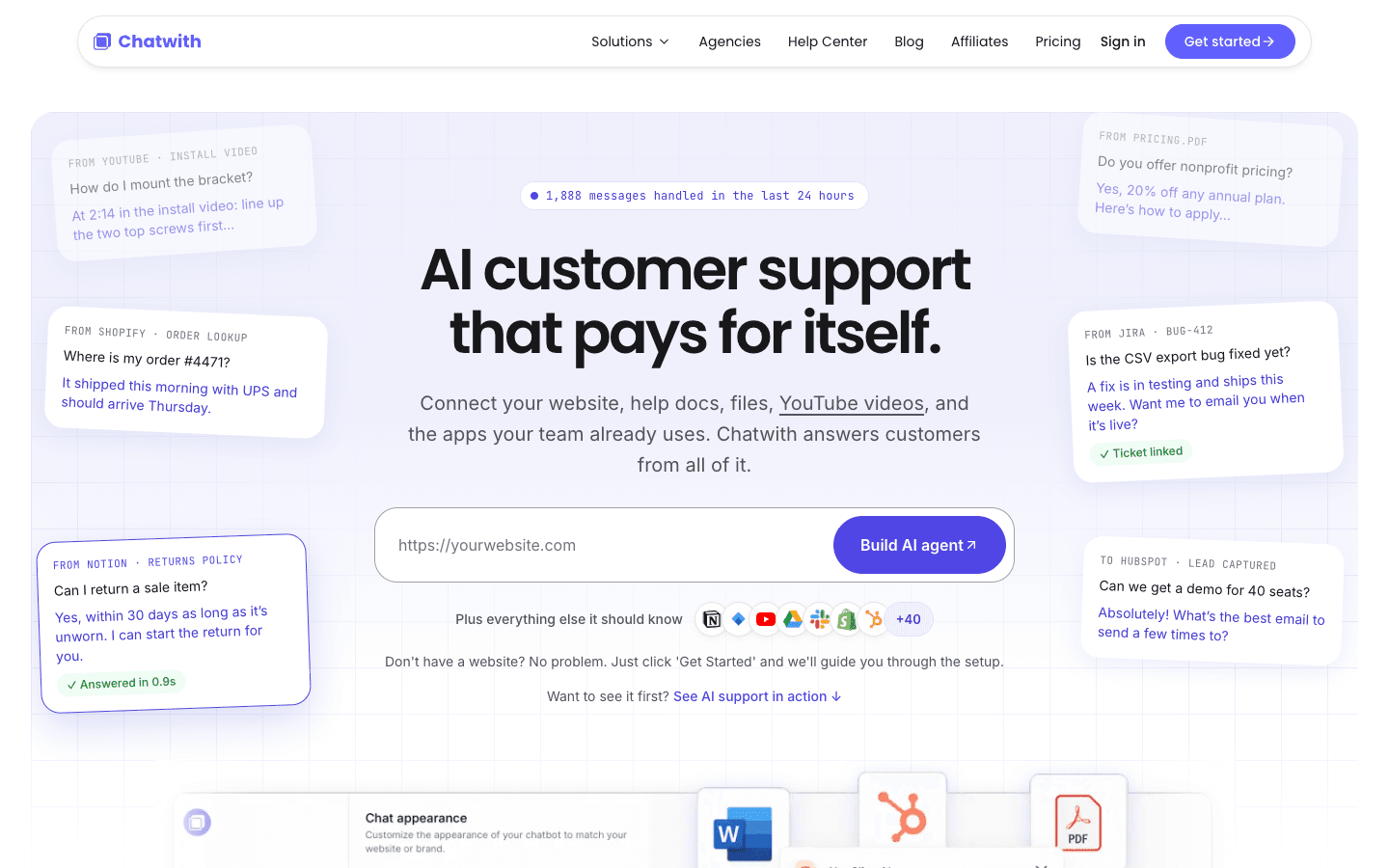
Reviewed Chatwith's site, docs, and pricing as of 2026-10-26; not deployed yet, so nothing here is hands-on. Chatwith (chatwith.tools) trains a support agent on your website, help docs, PDFs, plain text, and YouTube videos, then embeds it on your site — with MCP actions for Shopify order lookups, HubSpot lead capture, and Jira ticket status. Plans run $9/$19/$99/$399 per month, billed through Paddle, with published credits-to-conversations estimates. The vendor's own billing FAQ is the most useful page: it documents per-model credit costs, deactivation rules, and a generally-non-refundable policy.
Key Features
Agent trained on your content
Trains on your website, help center, PDFs, plain text, and YouTube videos; per-account training character pools from 2M (Starter) to 50M (Business), retrainable as often as needed.
MCP actions & AI Actions
Beyond answering, the agent calls your systems: Shopify/WooCommerce order lookups, HubSpot lead capture, Jira ticket status — 250 to 5,000 MCP action calls per month by plan.
Multichannel installation
One agent on your website plus WordPress, WhatsApp, Slack, Telegram, and email channels, with notifications by email or email+webhooks on higher tiers.
Agency & whitelabel toolkit
Client portal, custom domain, custom CSS/JS, remove-branding, and a management API for running client workspaces; lead collection and human escalation built in.
Pros & Cons
What works
- Trains from a wide source set — website, PDFs, help docs, plain text, and YouTube videos — with unlimited sources on every tier, including the $9 Starter plan.
- Does things, not just answers: MCP/API actions cover Shopify order status, HubSpot lead capture, and Jira ticket updates, with 250–5,000 action calls included by tier.
- Pricing page publishes the usage math openly — credits per plan, estimated conversations, and fixed $9 add-ons for extra credits, characters, or agents.
- Agency path is real: whitelabel, client portal, custom domain/CSS/JS, and a management API, on a GDPR-compliant base with a public DPA.
Watch out for
- No free plan — the pricing page shows no free tier, and the 7-day free trial badge appears only on Hobby, Standard, and Business, not on the $9 Starter.
- Credit costs vary up to 50× by model: the advertised '~50 conversations' on Starter assumes 1-credit replies, but Claude Opus 5.5 costs 20 credits per reply and GPT-6 Astra or Claude Fable 5.1 cost 50.
- The agent deactivates when a subscription lapses or plan limits are exceeded — it disappears from your website — an inactive agent may be deleted after a month, and fees are 'generally non-refundable' per the billing FAQ.
- Independent proof is thin: G2 lists exactly one review (5/5, May 2025), and no Trustpilot profile for chatwith.tools could be found as of 2026-10-26, so most evidence is the vendor's own pages.
Who is it for?
SaaS teams deflecting docs questions
Dedicated SaaS use-case playbook, help-center ingestion, and lead capture — the exact flow the homepage demos, from $9/mo.
E-commerce stores on Shopify/WooCommerce
Order-status actions answer 'where is my order' without your team; action calls are metered, so check volume against plan caps.
Agencies building bots for clients
Whitelabel, client portal, and management API exist as plan features — confirm which tiers unlock them before promising branded delivery.
Very low-traffic sites wanting a free start
No free plan; $9/mo buys ~50 estimated conversations. Free tiers exist elsewhere in this category before you commit.
Reviewed Chatwith's site, docs, and pricing on 2026-10-26. We have not deployed it — everything below comes from the vendor's public pages, its billing FAQ, and a single G2 review, not hands-on testing.
Chatwith (chatwith.tools) trains a support agent on your website, help docs, PDFs, plain text, and YouTube videos, then embeds it wherever your customers are. The twist is the actions layer: the pricing page meters MCP action calls per plan, and the homepage demos the agent pulling a Shopify order status, capturing a HubSpot lead, and checking a Jira ticket — work that normally lands in a human queue. Four plans from $9 to $399 per month, billed through Paddle, plus an agency track with whitelabel and client portals.
The Catch
Credits are billed per AI reply, and the model sets the price. Chatwith's own estimate — 250 credits ≈ 50 conversations on Starter — assumes 1-credit replies from cheap models like GPT-6 Luna or Claude Haiku 5.5. Switch the agent to Claude Sonnet 5.5 and each reply costs 10 credits; Claude Opus 5.5 costs 20; GPT-6 Astra and Claude Fable 5.1 cost 50. The same quiet month can cost 50× the advertised math, so who wastes money here is anyone running premium models without watching the usage dashboard. Two more rules from the billing FAQ: your agent deactivates when a subscription lapses or limits are exceeded — it disappears from your website, and an inactive agent may be deleted after a month — and fees are 'generally non-refundable.'
What it actually costs
| Plan | Monthly | Annual | Credits/mo | ~Conversations |
|---|---|---|---|---|
| Starter | $9 | $90/yr | 250 | ~50 |
| Hobby | $19 | $190/yr | 1,000 | ~200 |
| Standard | $99 | $990/yr | 10,000 | ~2,000 |
| Business | $399 | $3,990/yr | 40,000 | ~8,000 |
7-day trial badges show on Hobby, Standard, and Business; Starter shows none. Add-ons run a flat $9 per 1,000 extra credits, $9 per 10M training characters, or $9 per extra agent.
Where it fits
SaaS and Shopify stores get the clearest win: answers and order lookups without a ticket queue. Agencies get branded delivery at higher tiers. Want a free start first? Wonderchat and WotNot attack the same docs-trained-chatbot problem from different angles, and Chatwoot covers the human-inbox side if you outgrow deflection.
Chatwith is answer-first. Its MCP actions are agent-first.
Chatwith FAQ
How much does Chatwith cost?
Is there a free plan or free trial?
What can the Chatwith agent be trained on, and what can it do beyond answering?
Alternatives to Chatwith

No-code flow builder plus URL-trained AI Studio — praised support quality, double-metered pricing, one-sided review record.

Document-trained chatbot with the credit math published in full — cheap on default models, 10× the burn on frontier ones.

Open-source support inbox you can self-host free forever — the inbox is yours, the AI (Captain) is metered.
Related articles
All postsguide
AI Tools Comparison: Every Head-to-Head on This Site (2026)
Every AI tool comparison we've published, in one index: 14 head-to-heads across detection, humanizing, podcasting, video, job hunt, and support — each with pricing verified against the vendor's own page, a stated catch for every tool, and a decision table that picks a winner.
guide
Best AI Customer Service Tools 2026: 7 Tools Compared by Support Job
The 2026 AI customer service field, sorted by job: docs-trained chatbots (Chatwith $9/mo, Wonderchat $32.50/mo), document-trained bots with published credit math (FastBots $33/mo), open-source inboxes (Chatwoot free self-host), WhatsApp-first desks (Rasayel $30/user, Periskope $25/user), flow builders (WotNot $29/mo) — every price verified October 2026, with the catch for each.
guide
The Ecommerce Product Content Stack: From Product Photo to Launch Giveaway (2026)
A verified ecommerce content build — product photos (Photo AI Studio), video ads (KreadoAI), promo design (DocHipo), brand social (Mavic), ad approvals (Adpiler), launch giveaways (ViralSweep) — from a $31/mo launch floor to $187/mo full kit. Every price checked against vendor pages October 2026, with the credit traps named.