

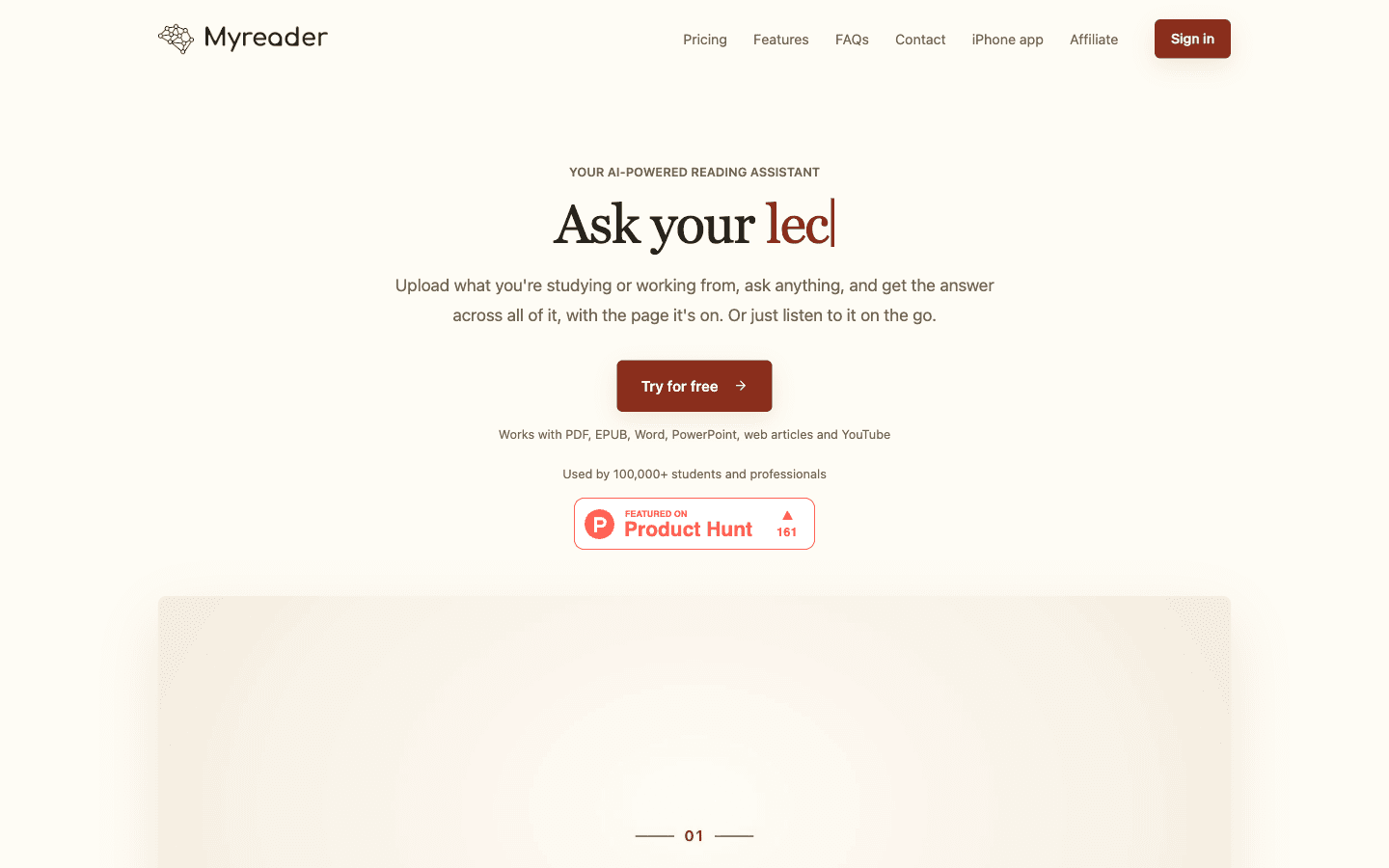
What is Myreader?
Reviewed Myreader's pricing page, homepage FAQs, and remaining public review trail on 2026-10-26 — no account made, nothing deployed. The product ingests PDF, EPUB, Word, PowerPoint, scanned docs (OCR), web articles, and YouTube videos, then answers questions across a document, a collection, or the whole library with citations that jump to the exact page; anything in the library converts to an audiobook in 50+ voices and 30+ languages. Free tier is 5 questions/day over 200 total pages (books deleted after 7 days of inactivity); paid runs $7.5–$15/mo annual. Third-party review record is thin: Product Hunt 4.7/5 from 6 mostly-2023 reviews, G2 unclaimed with zero reviews, no Trustpilot page.
Key Features
Chat with your library
Ask questions of a single document, a collection, or the entire library at once; answers arrive with in-line citations that jump to the exact page.
Text-to-speech audiobooks
Convert uploads into narrated audio in 50+ voices across 30+ languages, capped at 10 hours/month on Lite and 30 hours/month on Pro.
Universal document ingest
PDF, EPUB, Word, PowerPoint, and AZW files plus web article links and YouTube videos; OCR handles scanned documents on Lite and Pro.
Organized library and public classics
Collections with cross-device access, an iPhone app, and a free /explore library for chatting with public-domain books before paying.
Pros & Cons
What works
- Answers carry in-line citations that jump to the exact page in the source document — the feature staying users on Product Hunt praise most for research workflows.
- Queries run across a collection or the entire library, not one PDF at a time — the limitation Product Hunt reviewers explicitly escaped from ChatGPT plugins and their ~300-page caps.
- Any upload converts to an audiobook: 50+ voices, 30+ languages, 10 hrs/mo on Lite and 30 hrs/mo on Pro.
- Feature floor sits low — OCR, YouTube and article links, and citations all ship at $7.5/mo billed annually, with bulk upload the only Pro-exclusive.
Watch out for
- The question meter governs everything: 5/day on free, 250/month on Lite — roughly 8 questions per day before a hard stop mid-study-session.
- The free plan is a demo: 200 pages total upload and books get deleted after 7 days of inactivity.
- A 2024 Product Hunt review from a medical student documents a confidently wrong anatomy answer on a textbook lookup; no independent review base exists (G2 zero reviews, no Trustpilot) to gauge whether precision improved.
- Audiobook hours and monthly page quotas (5,000 Lite / 15,000 Pro) cap the listen-to-everything pitch, and page counts reset each month.
Who is it for?
Students with textbook and lecture-note stacks (med, law, MBA, seminary landing pages exist)
Page-cited answers match exam-prep workflows; the 250-question Lite quota suits a semester, the free tier does not survive one.
Researchers processing paper stacks
Whole-library queries over dozens of papers are the documented strength; precise fact extraction needs the citation clicked and checked.
Commute learners who listen
Audiobook conversion across uploads with 30+ languages, but 10–30 monthly hours bound how much of the library is actually listenable.
Businesses or publishers wanting preloaded content search
Custom solution only — a Calendly call, no self-serve team tier, no published business pricing.
Went through Myreader's pricing page, homepage FAQs, and what remains of its public review trail on 2026-10-26. No account created, nothing uploaded — a vendor-pages review, not a test.
Myreader does one thing. You upload what you're reading — PDF, EPUB, Word, PowerPoint, scanned docs, web articles, YouTube videos — then ask questions across one document, a collection, or the whole library. Answers arrive with in-line citations that jump to the exact page. Anything in the library converts to an audiobook narrated in 50+ voices across 30+ languages. The site claims 100,000+ students and professionals and maintains dedicated landing pages for med, law, and MBA students. The free /explore library lets anyone chat with public-domain classics before paying a cent.
The Catch
Myreader meters questions, not time. The free plan allows 5 per day against 200 total uploaded pages, then deletes your books after 7 days of inactivity — a demo, not a library. Lite ($7.5/mo billed annually) buys 250 questions a month, about 8 per working day; one exam-cram weekend burns through that. Pro's 1,000 questions at $15/mo annual is the realistic tier for daily use. Accuracy is the second cost. The most substantive Product Hunt review — a medical student in 2024 — describes a confidently wrong answer about foregut arteries that ended in a cancellation. The model behind that answer predates whatever Myreader runs today, and there is no independent record to check against: G2 shows an unclaimed profile with zero reviews, Trustpilot has no page, and the homepage testimonials are vendor-curated quotes dated 2023. When precision matters, click the citation and read the page — the product makes that easy, so use it.
What it actually costs
| Plan | Annual | Monthly | Quota |
|---|---|---|---|
| Free | $0 | $0 | 5 questions/day, 200 pages total |
| Lite | $7.5/mo | $10/mo | 250 questions/mo, 5,000 pages/mo |
| Pro | $15/mo | $20/mo | 1,000 questions/mo, 15,000 pages/mo |
Audiobook listening is capped separately — 10 hours a month on Lite, 30 on Pro — and page counts reset monthly, so a semester-sized upload needs headroom.
Where it fits
Students sitting on textbook-and-lecture-note stacks get the most value, and the pricing punishes light users least. Researchers get real mileage from whole-library queries, with the citation-checking discipline above. If the reading problem is really browsing assistance across the web, an assistant like Voilà fits better; for the wider shelf, see AI productivity tools.
Myreader meters questions, not pages — pages measure what you store, questions measure what you think.
Myreader FAQ
How much does Myreader cost?
What can you upload to Myreader?
What languages does Myreader work in?
Alternatives to Myreader

Compliance-first AI medical scribe with a genuinely free tier — a split review record and SGD-priced seats complicate the pitch.

Job-tracker-first workspace with AI resume tailoring — generous free plan, $40/mo Pro, no free trial.

ChatGPT-only workspace layer with folders, prompt chains, and bulk export — usable free core, $120/yr Pro, and almost no third-party reviews.